The Easel

7th June 2016

How Philip Guston, America’s Great Painter of the Night, Completely Reinvented the Sublime

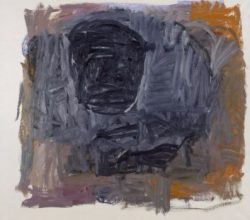
Philip Guston was slow to join abstract expressionism and, by the late 1950’s, desperate to leave. “A battle of wills with his art” over the next decade saw him emerge as a figurative painter. He was now all set for “what is perhaps the greatest last-act in 20th-century American art history: Guston’s all-hell-broken-loose id-under-pressure late figurative paintings.“ Images are here.
theartsdesk in Bilbao: The School of Paris at the Guggenheim Museum

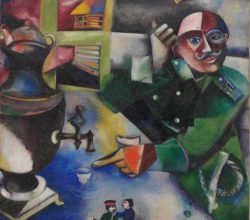
Guggenheim New York has lent its Bilbao offspring a host of early 20th century masterpieces. The title “School of Paris” implies a core narrative linking various art movements but the show doesn’t deliver on this. Who cares? The art explosion in Paris at that time has been told many times but still communicates “to all but the hardest of hearts, [the] still exhilarating story of modernism.” Background information and images are here.

Alex Katz: ‘Warhol ripped me off’

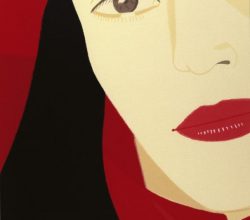
Most critics seem to like the current Katz show in London. The above reviewer seems to approve without exactly saying so. Katz images (often of his wife) are unsentimental, don’t give away much and are very popular. But misgivings persist. A review of some decades ago sums up the hesitation: “Katz is a poor draftsman. The idea of drawing as scrutiny of a subject … is quite alien to the pharaonic prettiness of his art.”

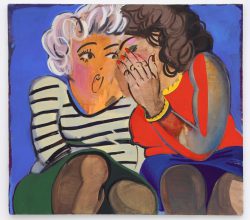
Ella Kruglyanskaya on Painting Modern Womanhood

Tate Liverpool is splurging this summer on figurative art. Kruglyanskaya is the most contemporary of three artists represented and articulates distinctly modern views. On fashion – “I don’t dismiss it as this light thing”. On the nude – “When you look at the nude, you’re just consuming her. It’s not like she can fight back”. On influences – “my idea of an homage to other artists [is a work] that still has my own twist.”

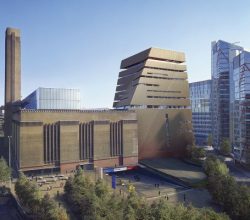
The promise of Tate Modern

Despite an initially patchy collection Tate Modern is now the world’s most visited modern art museum. Its next step is thus of some importance. Overcoming surprise at Tate’s success, this review of its new building ponders the options. The showcase for global art? “Interest in world art expands as narratives [focused on Europe and the US] become stale…. Already it is evident … that geography has become a significant theme.”

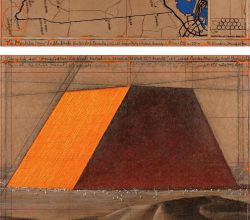
“It is Like Going to the Heavens”: Environmental Art Icon Christo on Creating the Largest Sculpture in the World

With his floating sculpture about to open in Italy (Lake Iseo, June 18), Christo is moving ahead on something even bigger. His plan – decades in the making – is to create a sculpture in Abu Dhabi that is comprised of 410,000 oil barrels – “bigger than the pyramid of Cheops”. Like all his projects, it does not express a sense of place: “it is a sculpture, a normal sculpture … [based on] a 7,000-year-old geometric form”.

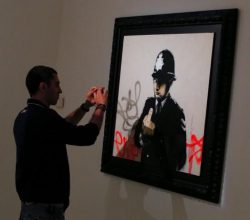
Private collectors display their Banksy art in Rome

After 20 years of anonymously creating politically acute street art, Banksy is the subject of a survey show in Rome. It has been organized by a not for profit group and not, we are assured, by the artist. Speculation is rife that he may visit. A curator declared breathlessly “In the history of Western art, no other artist has managed to bring themes of this magnitude to the attention of a global audience”.

31st May 2016

GALLERY ESSAY Richard Smith: The Incredible Lightness Of Being

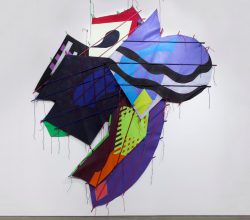
Arriving in New York from London, Smith quickly became prominent as a Pop artist. But he never fully signed up. An art critic at the time noted that Smith had “colour and a kind of newness absolutely separate from Pop Art”. By 1970 he had developed his iconic “kite” paintings. Art historian Barbara Rose argues that, while anything but orthodox, these works nonetheless sit inside the traditions of painting. “[T]he kites are shaped paintings– but only in their own and not any generic sense. They are paintings that come out of a tradition of painting and push it in new directions. They remain fascinating because they … are neither this nor that, not entirely image nor entirely object. They are brilliantly resolved in terms of composition and color relationships, but not in terms of their status as things in the world.”

Richard Smith died in April just after the close of his latest New York show.  This essay is reproduced with the kind permission of Barbara Rose and Flowers Gallery London and New York.

At the Barbican

A London exhibition featuring the work of foreign photographers has been widely reviewed. Many images focus on the north of the country, but the reviewer is skeptical of an overarching class narrative – “with rare exceptions, photographers find what they come looking for”. If so, perhaps they have unwittingly found the communities that made Britain Britain. Background on key photographers is here and more images here.

Image: Magnum

Guggenheim opens US’s largest László Moholy-Nagy exhibition in 50 years

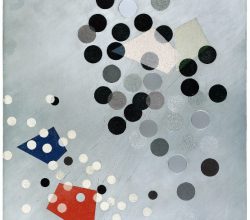
Moholy-Nagy taught at the legendary Bauhaus and embodied its ideal: the unity of art and technology. He experimented widely – painting, photography, assemblages and more. In a “powerful” retrospective, the coherence of this diverse output is evident – “light, transparency, planes, and depth”, underpinned by Bauhaus optimism that art and technology will make a better world. More images are here.

“I always try to have some logic to the job, to the work”: we interview letterpress legend Alan Kitching

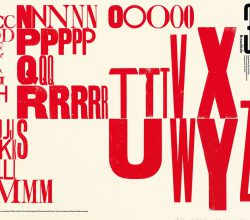
Letterpress printing, invented by Gutenberg in 1440, dominated nearly into the 20th century. Alan Kitching, one of the world’s foremost letterpress printmakers, exemplifies its reinvention as an art form. So how does it differ from offset printing? “Anyone can see it … it puts a bite into the paper … crisp, tangible, deferential to classical typography”.  A charming video (5 min) is here and fascinating backstory here.

Howard Hodgkin’s paintings get better and better

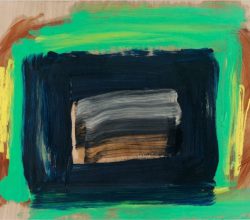
Asked to explain his paintings, Hodgkin tends to dodge and weave. His admits only that he “hates” painting and is a “representational artist of emotional situations.” Having said that, his paintings are distinctive in their spare brushstrokes and ravishing colour. An earlier review provides a characterisation as good as any: “Emotion is his fuel but, as Wordsworth said of a good poem, it is “emotion recollected in tranquility””.

Maria Lassnig: under the skin

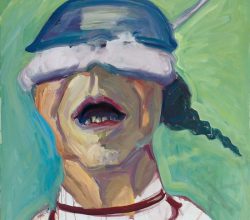
Maria Lassnig was devoted to one subject: self-portraits. Not a literal depiction, but the sensation of her body. Recognition came after decades of being ignored – when she died in her 90’s she was described as a rising star. And perhaps those years in obscurity rankled: “An avant-gardist discovered late isn’t an avant-gardist. In hindsight it can’t be appreciated how advanced my work was.” An interview with the artist is here.

Image: Maria Lassnig Foundation

Google Unlocks the Art in the Details with the Art Camera

Google Cultural Institute observes, without fear of contradiction, that close scrutiny of van Gogh’s six portraits of the Roulin family would involve plane trips. To solve the problem – and help preserve cultural masterworks – it has developed a robotic camera that creates super high resolution images of works of art. Twenty such cameras are being loaned to museums around the world. Initial results can be seen here.