The Easel

25th May 2016

A Five-Point Guide to the Work of Francis Bacon

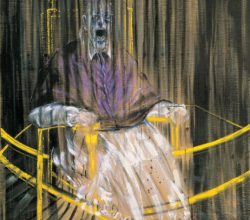
Bacon firmly considered himself a realist painter. Considering the nightmarishly contorted bodies that populate his paintings, this surprises – until Bacon’s true purpose is clear. He was not trying to represent the person but the sensation of that person. “His paintings strive not to tell stories but to clamp themselves [directly] on the viewer’s nervous system”. Interesting comments by other artists, and images, are here.Image: Tate
Jenny Saville: ‘I used to be anti-beauty’

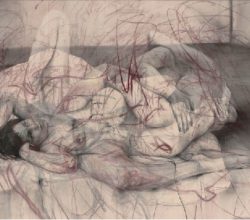
Life changes us all. In the case of British artist Jenny Saville she came to prominence in the 1990’s painting large nudes that challenged male concepts of female beauty. Now, observing her own children, she is re-evaluating the role of beauty in her art. “I don’t think there is anything wrong with beauty. It’s just what women think is beautiful can be different.” Further background on Saville’s art is here.

Rodin: sculptor as wrecking ball

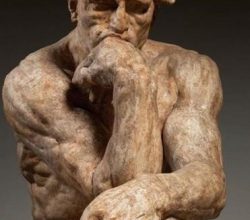
This Rodin sculpture show, previously reviewed, has moved to a new location and attracted a quite different review. For this writer, the highlight is Rodin’s ability to express not only carnality but also torment. When “The Thinker” is viewed from the front “notice how awkward and asymmetrical he is. It suggests … a mind and body working at cross purposes. It could easily have been called, “The Over-Thinker,” or “Stuck. Again.”

James Turrell Almost Stole a Painting by Juan Gris

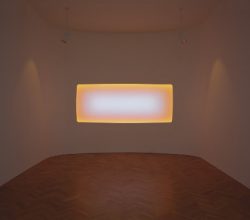
Why would an artist focus their art on the mixing and projecting of light? Turrell responds that light as an artistic raw material is no more difficult than sound.  Interest in the perception of light has an honourable ancestry – Turner, the Impressionists, Rothko. “[I]t’s just that I didn’t want to depict light, I wanted to use light itself.” Or, as one critic put it, Turrell’s art “happens behind your eyes, not in front of them”.

Nice Museum. Where’s the Art?

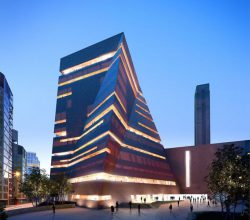
Academic research shows that gallery goers, on average, look at a masterpiece for just 28 seconds. If you are already the world’s most visited contemporary art gallery, what is the best way to use a big new building? Tate Modern has decided to emphasize more “participatory spaces” rather than contemplation of art, annoying the reviewer. “Art isn’t always about participation and popularity … Museums shouldn’t be, either.”

Perceptual Inventory: A New Anthology by Barry Schwabsky

“It’s abundantly clear”, the above writer argues, that grand theories of art’s progress have fallen apart. Art criticism does not offer a “master narrative” that distinguishes high art from kitsch. So, what do art critics have to offer? Aesthetic judgement, an ability to link current art to its antecedents, and the memorable phrase: “Gauguin’s Polynesian women … remained as mysterious to him as he was to himself.”

Robert Irwin’s Art Takes New Forms Right Before Your Eyes at the Hirschhorn

It must take courage for an artist to abandon something that is proven for the unknown. After experimenting with abstract expressionism Irwin steadily abandoned images because “they implied messages to be deciphered, messages to be read, and he wanted to get away from all that. By 1970 he … put away his tools, closed his studio and announced that environments alone, perception altering spaces, would be his concern”

17th May 2016

Off The Grid: Francois Morellet At Ninety

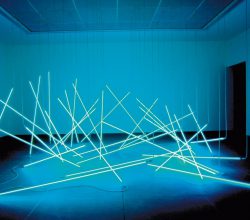
A spate of articles appeared at the end of April reviewing the London shows of French minimalist artist François Morellet. He died a few days later, just after his 90th birthday. Regarded within France as one of their most important artists, his geometric paintings and neon tube works were often made by applying simple decision rules rather than artistic judgement. Morellet discusses his work in this video (5 min); images are here.

Cao Fei, MoMA PS1, New York — ‘Pithy and profound’

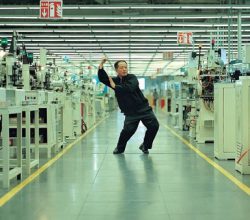
In 2006 Beijing-based Cao Fei took a six month artist residency at an Osram lighting factory. The resulting video about workers and their inner lives is a highlight of her first solo show in the US. Even though only in mid-career, she is regarded as a gifted chronicler of China’s cultural transformation “Cao finds rich fishing grounds in that unfathomable transformation, in the urban century’s intertwined excitement and despair.”

How Richard Serra Shaped the Discourse about Public Art in the 20th Century

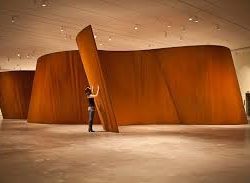
Serra remembers watching, as a child, the launching of a large ship. “All the raw material that I needed is contained in the reserve of this memory.” Not surprisingly, his massive steel sculptures are renowned for conveying a sense of presence: “Rather than prompting you to simply observe, Serra makes you constantly renegotiate your relationship to an artwork … How [his] work alters a given site is the issue.”

Image: Wikipedia

With Its New Building, SFMOMA Cements a Place on the World Stage

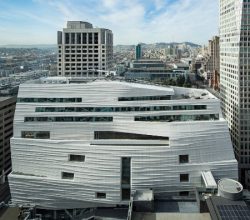
SFMOMA has just scored a trifecta – a new building, the loan of a major private collection and a new capital fund. The building – “a triumph” – is graceful, functional and the largest contemporary art museum in the US. The art – reportedly worth $1bn – is ”an intensely (almost hilariously) blue-chip selection of work—big money, male, and white, in other words”. An excellent 3D graphic on the building is here.

Mona Hatoum, exhibition review: Striking, seductive and hard-hitting

Lebanon’s civil war stranded Hatoum in London so she stayed and made her life there. Reviews of her retrospective are numerous, underlining her prominence, but opinions are divided. One critic says “The ideas are there, but not the visceral effect.” But the above writer disagrees – Hatoum’s installations “succeed abundantly: this show is at once captivating and unsettling.” A bio piece is here and more images here.

Giorgione and the problem of attribution, with Charles Hope

A Royal Academy exhibition poses a Renaissance whodunnit. Giorgione was supposedly an influential Venetian artist of the period. A few ravishing paintings are, it is agreed, his; many more are seemingly attributed by guesswork. The linked video (5 min) shows how flimsy the historical narrative might be – “it is impossible to say how much influence he had … and what that influence might have involved.” A full review is here.

The Subversive Sculptural Collages of Isa Genzken

Isa Genzken’s art is nothing if not eclectic. An influential sculptor she also works in painting, photography, collages, drawings and film. Her sculptures don’t easily fit a category. They incorporate mannequins, thrift-store finds and Ikea junk, fulfilling her aim to “put things together that were previously unconnected …like a handshake between people.” Background information is here and images here.