The Easel

27th September 2022

William Kentridge, Royal Academy, review: An overwhelming, operatic epic from the South African giant

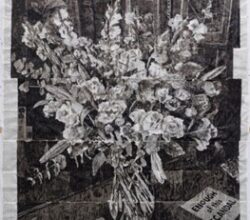
A solo show at the Royal Academy’s main gallery is an accolade that comes with high expectations. Reviews of Kentridge’s show are curiously scattered, as if critics somehow can’t find its epicentre. Is it his animated films, his charcoal drawings, his sculptures or his paintings of flowers? The writer approves of this diversity which gives the show an “operatic” feel. Another critic is less enthused – Kentridge’s erudition is “alienating … he creates with too much head and not enough heart”.
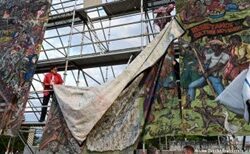
Crushed between the fronts

To the relief of many, this year’s Documenta, the highly influential five yearly survey of contemporary art in Germany, has closed. From its beginning in June, organisers, German politicians and the press have traded accusations of antisemitism and racism. Listening to the curators, it seems likely that they and the organisers had divergent objectives. “It’s a dreadful embarrassment” says one critic. “The whole thing has rotted into a festival of bad faith and victimology”.

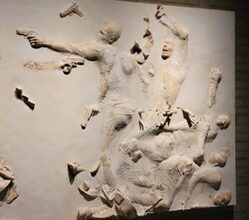
Shockingly, Brad Pitt turns out to be a very fine sculptor

You cannot accuse the editor of not having a sense of humour. Pitt began artmaking as a form of therapy after his divorce from Angelina Jolie. Sent to review Pitt’s debut exhibition, this esteemed British critic admits to having had low expectations. Instead, he found works that are “powerful, worthwhile”. They include a neoclassical frieze and a worked metal coffin, all loosely connected to themes of pain and violence, that the actor says were a product of “a radical inventory of the self”.

The Art World in an Age of Rage

A fiery essay on how fraught race relations in the US can impact art museums. (Its inclusion does not imply that The Easel endorses its views.) When museums ignore work by artists of colour or don’t hire qualified curators of colour, they are asking for trouble. Ditto for the work of female artists. What’s the solution? The writer thinks that “race-based expectations” could have a “paralyzing” effect on museums. Yes, just as does the persistent exclusion of groups of artists from museum walls.

Korean Modern art gets its long-overdue spotlight at LACMA

When Korea’s “isolationist” Joseon dynasty fell in 1905, it was the start of transformative changes – WW2, the Korean War, partition. Culturally, “things Western became equated with things modern”. Initially, the art that followed was, complains this writer, “derivative”. Perhaps, but deeper changes had begun. By the 1970’s, Korean monochrome painting (dansaekhwa) emerged to great acclaim, foreshadowing the global cultural powerhouse that is now modern Korea. More images are here.

Michael Heizer’s Empty Empire

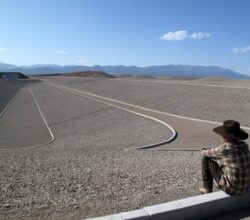
Heizer located City, his monumental land artwork, in the Nevada desert because “there isn’t anything else there”. That perspective betrays a “baffling incuriousness” about the larger history of Native American occupation of that land. Not all Native Americans are offended by the artwork. However, it is “comically obvious” (indeed, ironic) that the “interconnection of self and land” never occurred to Heizer as he laboured for 50 years creating the work.

“An Eye at the End of My Pencil”: Bridget Riley’s Drawings

It’s easy to see why Bridget Riley admires Seurat. His pointillist paintings clustered dots of colours to create the impression of some other colour. Such explorations of perception are also at the heart of Riley’s art, both in her shimmering monochromatic lines and in her colour juxtapositions. As a Chicago show makes clear, behind these abstractions are her drawings, the “seeds” of her art, where she labours to answer the question that Seurat posed – “what is it that we are looking at”?

20th September 2022

Photography trailblazer William Klein dies at 96

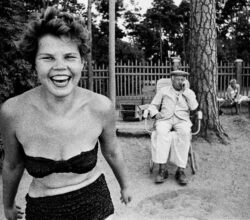
In 1954, Vogue persuaded Klein that his brash, graphic photography was just what they wanted for their fashion magazine. Shooting fashion out on the street proved influential at the magazine and beyond. More rules were broken with his book of New York street photography that focused on “all the exuberance, violence, and off-beat beauty a city contains”. Published in 1956 – in Paris, not the US – it was instantly acclaimed. Says one critic, Klein was “one of the greatest filmic artists of his age”.

The Iron Curtain: Christo and Jeanne-Claude

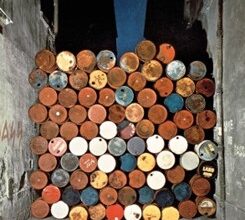
A reminiscence. In 1962, Christo and Jeanne-Claude used discarded oil barrels to block off the tiny rue Visconti in Paris. Police dismantled it after just seven hours but it was an indicator of the bigger projects to come. Their barrels were intended to confront, creating a tension between viewer and environment. Concealment was also part of this work, as was its modular elements and its temporary nature. Like all their works, it was intended as a “gentle disturbance”.

Storms, sharks and rippling bodies – but was Winslow Homer lost at sea?

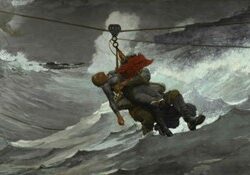
Homer, a household name in the US, is little known in Britain. Does a “magnificent” survey in London bring the usual acclaim? Not really. Homer’s naturalist scenes were often unresolved. Will the sailor survive the shipwreck? Are soldiers at war always heroic? But, what to American eyes adds tension fails to impress this writer. “Its difficult, today, to get excited about this overly-explanatory visual quality. In general, there’s too much boyish, adventuresome melodrama, and insufficient mystery.

Albert Bierstadt unveiled the epic vistas of the American West

Manifest destiny was the idea that settler expansion across the American continent was but one more step toward American greatness. A young Bierstadt saw himself as just the artist to paint this vision. His landscapes of the West were huge, immensely popular, but appear now to express a “dream of conquest”. Railroad magnates loved them, but an observant Mark Twain thought them too much – all those silvery mountains, clouds and sunlight were “considerably more beautiful than the original”.

Rodin & Degas: Impressionist sculpture

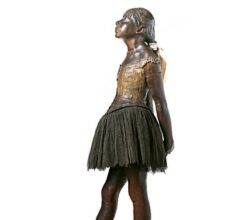
Both Rodin and Degas were fascinated by dance. Intending all his work for public display, Rodin tried to capture the “emotionalism” of contemporary dancers, such as Nijinsky, in classical sculpture. Degas’ interest was classical ballet – as his paintings attest – and he used his sculptures as private experiments about the figure and the effect of worked surfaces on light. As one critic observes, two different approaches but the same objective – “modern figural expressiveness”.