The Easel

13th July 2016

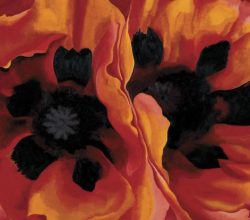
Georgia O’Keeffe at Tate Modern review: The artist who tried to create a new kind of painting for Modern America

This London retrospective is already drawing big crowds. Its popularity notwithstanding, there are mixed views among the critics.  One declares the show to be a great success but another observes that O’Keefe had “no relish for paint”. The above writer takes the middle ground: She developed “a new way of seeing things in the world” but “O’Keefe’s works are [not] truly great paintings”.
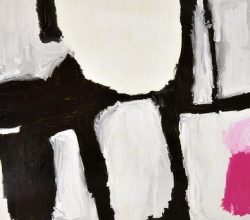
Sally Gabori retrospective

Some of the heroes of Australian indigenous art are late bloomers indeed. Relocated from her home as a young adult, Sally Gabori started painting when she was 81. She painted the home she left. Those images, derived from memory, are almost abstractions. But they still speak to her attachment to country – “it’s the colours of the tropics so to speak, but it’s also the life of the tropics.” Some images are here

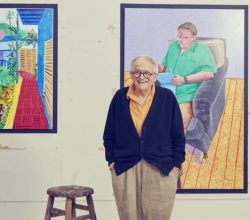
David Hockney, 82 Portraits and One Still Life, review: an odd lack of anything remarkable going on

Following the death of a studio assistant, Hockney started a series of portraits. They showcase his genius with colour as well as his compositional talent. But is this exhibition up to the standards of this acclaimed artist? Some critics sidestep this question but the above writer makes an attempt: “on a big abstract level it’s exciting but as pictures of people it’s pretty flat.” An interview with the artist (2.5 min) is here.

If we return Nazi-looted art, the same goes for empire-looted

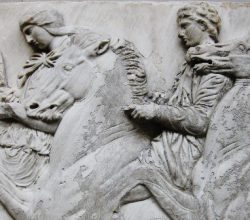
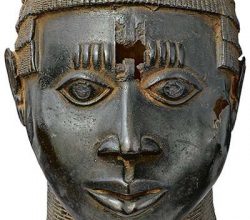
Startlingly, the Elgin marbles may not be the worst example of looted art. “European museums are full of artworks taken from countries under colonial control. [P]riceless Chinese porcelains … sacred Australian Aboriginal objects … bronze sculptures made to honour the kings of what is now Nigeria. These histories of force and desecration make Elgin’s bribes look quaint, even gentlemanly.”

Nan Goldin’s “Ballad of Sexual Dependency” Lights Up MoMA

The photographer Nan Goldin led a “high risk” lifestyle during the late 1970’s and 1980’s. Her images from that time have been assembled into a slideshow that is now an acclaimed work. “Goldin’s [Ballad] is a record of loss that, like Puccini’s “La Bohème,” contains its own partial redemption. A mix of beauty, horror, and despair, her images also reveal a lust for life rare not just in art, but in living.” An interview with Goldin is here.

Philadelphia Offers a Full-Fledged Summer of African Art

Philadelphia is celebrating the diversity of African art with exhibitions of traditional objects, contemporary textiles/fashion, architecture and photography. Diversity is on show as is the health of artistic activity at the street level. Photography is one example of this. Another is West Africa’s creative street couture. The textiles, it turns out, are made in Holland, but are claimed by stylish African women as their own.

Image: Penn Museum

Wydr is Tinder for buying art

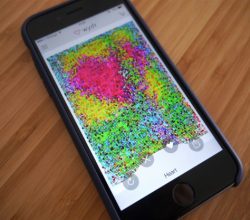
The effort to bring art sales online is unrelenting. Even as one startup closes its doors and Amazon Art makes seemingly slow progress, another newcomer arrives. New ventures such as Wydr are basing their offering on simplicity – “[swipe] right when you like what you see and left when you don’t”.  And they seem to be steering well clear of the bigger galleries – “The average shopping cart value is $430”.

5th July 2016

A Life of “E”s

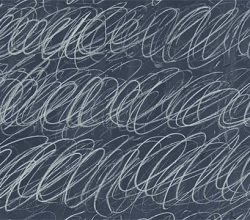
Morgan Meis, the Easel’s Contributing Editor, just co-authored a new book, Dead People. It is a collection of obituary essays described by one reviewer as “tart, funny, sad, occasionally angry and always surprising … an intellectual, artistic, and political history of the 20th century.” One essay is on the feted American artist Cy Twombly which is reproduced here with Morgan’s permission.

“[Twombly] must have liked the way, also, that his letter-and-word-scrawled canvases were a jolt to expectations. Paintings are supposed to be of images, while writing is supposed to use words. Words go one place, images another. You can’t really read a painting, Twombly realized, so you have to see the language found in a painting on a different register.”

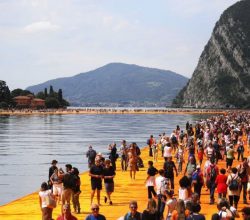
Artist Christo’s hugely popular floating walkway in Italy closes after 1.2m visits

Christo’s floating walkway, installed on Lake Iseo, has come and gone. Huge crowds arrived “from everywhere to walk to nowhere”. A few grouched about costs and about the walkway going to an island owned by the Beretta armaments family. Mostly, it seems, it generated calm pleasure, suggesting to one critic the need for a re-think of “what [has] been called public art”. More images are here.

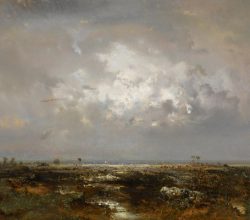
Getty exhibition makes a case for the enduring power of Theodore Rousseau

Theodore Rousseau was nearly great. His “luminous” landscapes sold for huge sums. But a mere seven years after his death the first Impressionist exhibition announced an entirely new way of portraying life – especially city life. His eclipse thus began. Conventionally described as merely a precursor” to Impressionism, he was in fact better than that – portraying “something marvelous [that was] slowly disappearing from consciousness.”

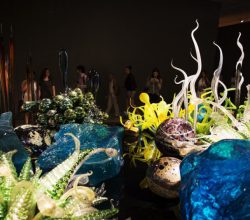
Dale Chihuly at the ROM: Pretty, vacant

What is the dividing line between “pretty” and “art”? Dale Chihuly’s glass sculptures are held in many museum collections but are beset by the same debate that also attaches to Jeff Koons. Although popular, Chihuly’s studio produces a large output and his involvement is only indirect. Is it art? “An embrace of bloated excess for its own sake” concludes this writer.  An interesting video is here (24 min).

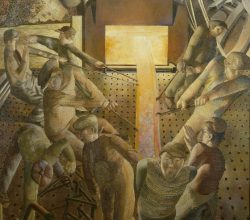
The Passion of Stanley Spencer

British art between the wars is sometimes thought parochial. Not so Stanley Spencer. Borrowing from Botticelli and Giotto, his art expressed a deep religious vision. Human relationships offered a form of resurrection. He admired industrial workers, seeing “spirituality in [their] ritualistic routines”. At the same time his candid nudes seem modern, opening a door for Lucian Freud. Ample justification for sustained popularity.

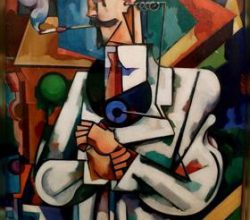
Amadeo de Souza-Cardoso

Souza-Cardosa didn’t lack confidence. Arriving in Paris in 1905, he described the art scene as “mediocre apart from a few things”. Friendships with Modigliani and Brancusi gradually drew him into the avante garde and, from around 1910, he produced many significant works. The 1918 Spanish flu pandemic claimed him, his talent not really fulfilled. A retrospective in Paris has this writer proclaiming him as “one of the greats.”

The Missing Link: Subhash Kapoor’s Suppliers in India Are (Finally) Getting Rolled Up

The wheels of justice grind slowly in India. Subhash Kapoor, a New York based dealer of Asian antiquities, was arrested in 2011 on charges of trafficking items stolen from temples. His blue chip client list included Australia’s National Gallery and the Getty Museum in Los Angeles, both of which have had to repatriate expensive items with suspect provenance. With recent arrests the case continues to broaden.