The Easel

17th May 2016

Off The Grid: Francois Morellet At Ninety

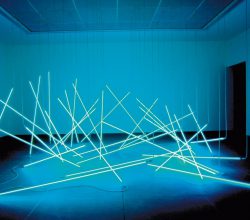
A spate of articles appeared at the end of April reviewing the London shows of French minimalist artist François Morellet. He died a few days later, just after his 90th birthday. Regarded within France as one of their most important artists, his geometric paintings and neon tube works were often made by applying simple decision rules rather than artistic judgement. Morellet discusses his work in this video (5 min); images are here.
Cao Fei, MoMA PS1, New York — ‘Pithy and profound’

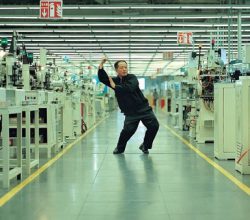
In 2006 Beijing-based Cao Fei took a six month artist residency at an Osram lighting factory. The resulting video about workers and their inner lives is a highlight of her first solo show in the US. Even though only in mid-career, she is regarded as a gifted chronicler of China’s cultural transformation “Cao finds rich fishing grounds in that unfathomable transformation, in the urban century’s intertwined excitement and despair.”

How Richard Serra Shaped the Discourse about Public Art in the 20th Century

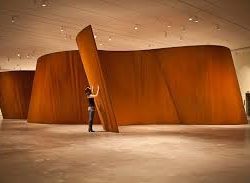
Serra remembers watching, as a child, the launching of a large ship. “All the raw material that I needed is contained in the reserve of this memory.” Not surprisingly, his massive steel sculptures are renowned for conveying a sense of presence: “Rather than prompting you to simply observe, Serra makes you constantly renegotiate your relationship to an artwork … How [his] work alters a given site is the issue.”

Image: Wikipedia

With Its New Building, SFMOMA Cements a Place on the World Stage

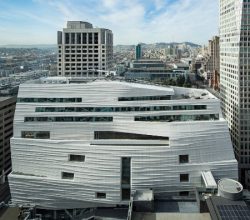
SFMOMA has just scored a trifecta – a new building, the loan of a major private collection and a new capital fund. The building – “a triumph” – is graceful, functional and the largest contemporary art museum in the US. The art – reportedly worth $1bn – is ”an intensely (almost hilariously) blue-chip selection of work—big money, male, and white, in other words”. An excellent 3D graphic on the building is here.

Mona Hatoum, exhibition review: Striking, seductive and hard-hitting

Lebanon’s civil war stranded Hatoum in London so she stayed and made her life there. Reviews of her retrospective are numerous, underlining her prominence, but opinions are divided. One critic says “The ideas are there, but not the visceral effect.” But the above writer disagrees – Hatoum’s installations “succeed abundantly: this show is at once captivating and unsettling.” A bio piece is here and more images here.

Giorgione and the problem of attribution, with Charles Hope

A Royal Academy exhibition poses a Renaissance whodunnit. Giorgione was supposedly an influential Venetian artist of the period. A few ravishing paintings are, it is agreed, his; many more are seemingly attributed by guesswork. The linked video (5 min) shows how flimsy the historical narrative might be – “it is impossible to say how much influence he had … and what that influence might have involved.” A full review is here.

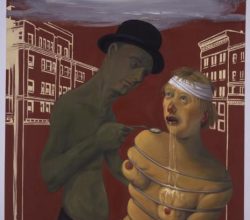
The Subversive Sculptural Collages of Isa Genzken

Isa Genzken’s art is nothing if not eclectic. An influential sculptor she also works in painting, photography, collages, drawings and film. Her sculptures don’t easily fit a category. They incorporate mannequins, thrift-store finds and Ikea junk, fulfilling her aim to “put things together that were previously unconnected …like a handshake between people.” Background information is here and images here.

10th May 2016

Revisiting Marisol, years after her heyday

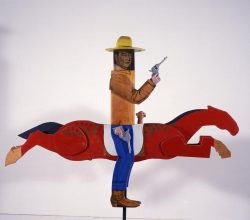
Sometimes artists just drop off the radar screen. Marisol Escobar, who died last week, was a star of New York’s art world in the 1960’s. Her pop / folk art sculptures, widely acclaimed in 1970, were by 2000 all but forgotten. A retrospective in 2014 signaled new interest and brought the judgement that she was “more interesting, more accomplished, and more original than [most of] her generation”. Some images are here.

From the archives: Wallpaper’s 2008 profile of the late Zaha Hadid

The recent death of star architect Zaha Hadid was widely covered, and appropriately so. A good video piece by Will Gompertz (2 min) is here and images of her work here. The linked piece is perhaps the pick of the lot. “[Zaha’s] architecture is the greatest art of the moment.” Her Cincinnati Contemporary Arts Centre is “a delightful architectural metaphor for the cliché of blurred boundaries between art and life.”

The Wondrous Critic

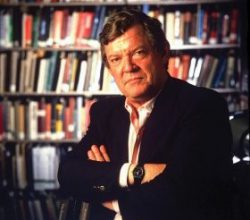
Robert Hughes’ strong views and vivid prose thrilled many. But not all. One writer complains that some essays in a newly published anthology have “a skunk stripe of nastiness”. The above review takes a broader perspective.  “Hughes’s excellence could not be contained in the relatively narrow, not to say paltry, confines of his stated profession. [He] had perhaps the best eye of any critic of his age.”

Nicole Eisenman’s Paintings Stand Out from the Crowd at the New Museum

Ignoring the popularity of abstract art, Nicole Eisenman’s preferred style is figuration. One critic’s description of her as “great” may be hasty but her humorous and allegorical work is widely praised. “I paint the figure because I know the world through my body and I understand my desires and my anxieties through my body, and the desires and anxieties of our culture.” A short (3 min) video of the artist is here.

‘It is what it is.’ Dan Flavin’s iconic light fittings in the Ikon Gallery

The popularity of Flavin’s minimalist light sculptures endures – as does their ability to intrigue. Although he trained for the priesthood Flavin discouraged interpretations that emphasized the spiritual element of his work. He felt, according to one critic, that “all humanistic content in art was mushy and to be avoided”. Or, in Flavin’s own words “Everything is clearly, openly, plainly delivered”.

How Identity Politics Conquered The Art World

Jerry Saltz tries to answer a tough question – what is the defining character of contemporary artistic activity? “After the ’80s, we seem to have lost the reflex to recognize or name new art movements. Art in this era has veered dramatically toward an approach that hasn’t been seen in the West for more than 1,000 years… [Its] a real aesthetic movement – the art of the first person.” (His core argument is at the start of this lengthy article.)

Against the Widening Gulf: Arab Art in Tehran

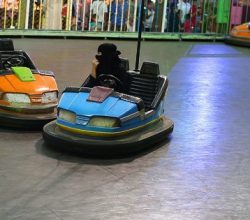
Contemporary art in Tehran is, it seems, always viewed through a political lens – even more so when the art on show is drawn from other Gulf countries. Not surprisingly, key social tensions are a common theme – modernization, religious strictures, regional rivalries. One image on display features women “gleefully playing bumper cars—the closest women can come to driving in Saudi Arabia.”