The Easel

29th September 2015

Tate Modern Finally Gives Pop Art’s Long-Ignored Female and Global Artists Their Due

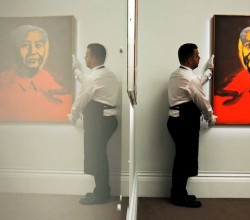
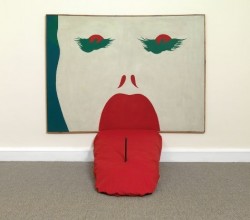
Pop art has always been a very American story – think Warhol – but an exhibition at the Tate aims to bring non-US artists into the narrative. The curator observes “History is written through commerce. If there is no commercial support, then they didn’t enter the world.” Often unaware of what was happening in the US, these unsung artists nonetheless picked up a shift in media imagery and responded to it.
A Story Behind The Arrass

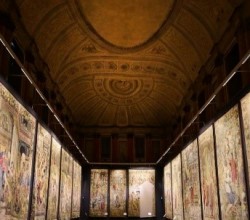
As soon as Cosimo de’ Medici unexpectedly came to power in Florence, he started to splash the cash on art. An early project was a set of 20 giant tapestries that are masterpieces of Italian Renaissance art. After extensive restoration these works have been reunified as a complete set for the first time in 150 years. They are touring Italy and went on display in Florence last week. A video (1.5min) is here.

A delayed tribute to France’s most famous woman artist

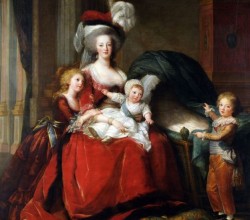
Such was Vigee Le Brun’s ability that, when she joined the Royal Court, it was hoped her portraits might fix the unpopular Marie Antoinette’s PR problem. No such luck. Given her royal connections, Vigee Le Brun had to flee Paris in 1789, but simply grew her reputation elsewhere in Europe. Despite enduring popularity, this is her first ever retrospective in Paris. An interesting video (4 min) is here.

This is bad news for people who spend millions on art

The art market moves in mysterious ways. Under increasing threat of litigation, some artist foundations no longer rule on the authenticity of works by the artist. Art experts are also becoming reluctant to give opinions. This has boosted the price of works with established authenticity but “the gray area for uncertified works … has become even grayer.” One possible consequence – more forgeries.

‘Portraits: John Berger on Artists’, by John Berger

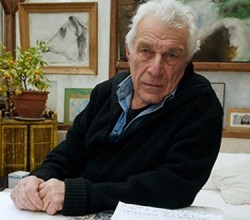
John Berger shook things up in his acclaimed 1972 book “Ways of Seeing” where he argued for including social context in art criticism. Now aged 88, his new book on portraiture takes a more conventional approach but is not lacking impact. “[A]rresting” is the reviewer’s assessment, “history filtered through a temperament … a definitive self-portrait of one of Britain’s most original thinkers.”

Cecily Brown Discusses Style, Insecurities, and Knowing When a Painting Is Finished

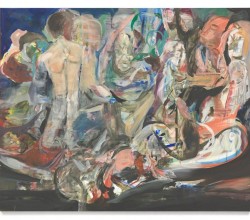
Cecily Brown’s CV reads like she is the next big thing. Prizewinner at the Slade School, represented by Gagosian, works in major collections, high prices at auction and not yet 50. She self-describes as “abstract at first glance… but full of figurative elements”. But, she frets. “I might love something but 10 minutes later questions creep in likeIs it enough that it’s pleasant to look at?” Her current show is on in Berlin.

The Anti-Expressionist: Jack Tworkov’s Paradigm Shift

Tworkov may not have been a giant of 1960’s Abstract Expressionism, but he was influential – and different. There was no out-of-control lifestyle. He wrote noteworthy essays. But most eye-catching was his switch from emotional abstraction to cerebral geometries. As the reviewer notes “of all the Abstract Expressionists, Tworkov traveled the farthest, an apostate from the temple of the emotive stroke”. That took strength.

22nd September 2015

Ai Weiwei at the Royal Academy: a triumphant display of poetic objects with political intent

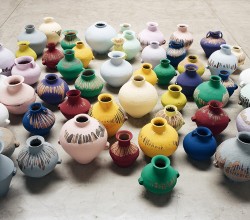
This might just be the most anticipated art exhibition in London this year. Enthusiastic reviews abound though a few struggle with Ai’s merging of art and activism. This artist’s courage and force of personality are beyond doubt as is the ability of his work to generate a sizable political punch. Ai may much prefer that punch were being delivered at home rather than abroad. A video interview (3 min) with the artist is here.

Frank Gehry’s Winning Egotism

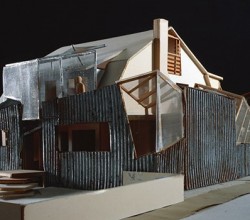
By any measure Frank Gehry has been a force for innovation in architecture and has produced some iconic buildings. Detractors claim that his designs are showy – great exteriors but neglectful of internal uses. A retrospective in Los Angeles errs toward flattery and the linked essay follows its cue that Gehry be viewed as an artist. An equally good but more neutral review is here. An excellent video (7 min) is here.

Kongo: Power and Majesty review – African treasures inspire awe at the Met

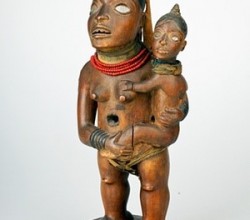
The traditional view that Europe brought civilization to the Dark Continent gets hammered in a landmark exhibition of African sculpture at New York’s Metropolitan. “It is a scholarly blockbuster” and some large scale sculptures are “a high point in the history of art”.  Overall, the show “exposes our own museums’ complicity in the scramble for Africa, and the deportation of not only African people but African things.“

Simon Schama’s eye for a story

Can the story of a nation be told through its celebrated portraits? Historian Simon Schama aims to do this in a book and matching exhibition at London’s National Portrait Gallery. Overall, there is approval of the eclectic narrative that emerges. “[I]t’s the pathetic default mode of the modern book review to attack a book for all the things it isn’t, rather than look closely at what it is. And this [book] is both excellent and highly unusual.”

A master of the eloquent insult: Brian Sewell was one of a kind

The tributes being written for British art critic Brian Sewell are, for the most part, conflicted. In trying to see the world through the eyes of the common man, he came across as a populist – famous for rudeness, his dismissal of female artists and dislike of most modern art and many art critics. However, he had deep expertise in art which he applied with transparent honesty. Mostly, he got people talking about art.

We Must Not Be Isolated

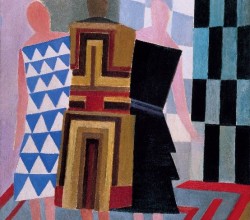
Ali Smith displays her celebrated writing talents in a personal take on the Tate’s recent Sonia Delaunay show. A contemporary poet described Delaunay’s dresses “as if they made women into works of art. [At] the dance hall … she, Robert and their friends would strut their stuff … usually dressed in Sonia’s early simultaneous clothes, bright swirls of patched colour-amalgam which gave them the visible status of glorious jesters”.