The Easel

24th June 2025

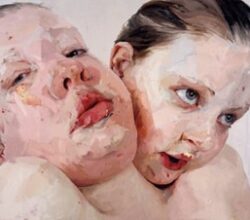
How Jenny Saville turns paint into flesh

Saville’s acclaimed works look like portraits except that she says they are actually paintings about the act of painting. She acknowledges the influence of compatriots Bacon and Freud but also abstractionists like de Kooning and Twombly. From them she draws “energy” but what she paints are fleshy, visceral, imperfect bodies that impart, says one writer, the “ungraspable but omnipresent realness of others”.  Amidst a string of 5-star reviews for Saville’s retrospective this writer says “she has the verve of a great artist”.
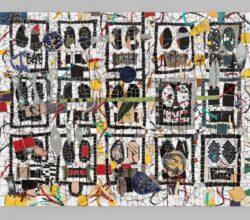
Rashid Johnson

Starting out, Johnson was called “post-Black” for his avoidance of racial stereotypes. Now honoured with a mid-career survey, do we see him more clearly? Besides his original medium of photography, he works across video, painting, mosaic and sculpture. One critic groans about “hectic conceptualism” – lots of ideas, some great but others that are “too esoteric”. The linked piece notes all the allusions and wonders if Johnson’s work is “activism [or just] décor … I’m not so sure”.

Curator Robert Fucci Unpacks the Narrative Intrigue of ‘Vermeer’s Love Letters’

To celebrate its renovation New York’s Frick is showing three Vermeers, each a genre scene that focus on a favourite theme, the love letter. Dutch society in Vermeer’s day was not always willing to let women choose their partners. The love letter, often transmitted by one’s maid, was one way to steer events in a desired direction. So, in these paintings, there is dramatic tension – will love win out? Says one critic “three staggeringly beautiful works”. A backgrounder is here.

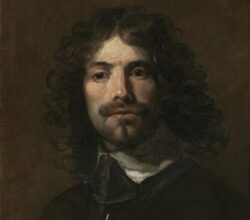
Historic portrait by ‘Britain’s Caravaggio’ bought for the nation

London’s National Portrait Gallery says William Dobson was “the first great British painter”.  Few remember him today but that may change with the official purchase of his self-portrait. Painted around 1637, the work stands out amidst that era’s “stiff” portraits. It is fluent, with thickly applied paint and “oozing romantic self-absorption”, giving it  an“un-English” psychological mood. “Suddenly, out of nowhere, we have a native Caravaggio”. The gushing official announcement is here.

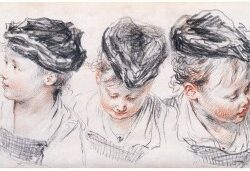
Antoine Watteau’s studies in elegance

When we think Watteau, we think of paintings of aristocratic frivolity. He was slow, it seems, to pick up his painting brushes but, when it came to drawing, he was “almost obsessive”. He drew constantly, with some images eventually appearing in his paintings. Yet Watteau’s repeated alteration of his drawings is evidence that he saw them as artworks in their own right. His skill in focusing on a figure “gives many of his drawings an almost cinematic quality, which he never fully reproduced in paint.”

Paul Poiret: How Fashion’s Maverick Turned Couture Into Art in Paris

Poiret opened his fashion house in 1903. Soon he was famous for his “streamlined and unstructured” fashions that liberated women from the corset. These clothes, often colourful and “draped rather than tailored”, celebrated natural form and were a “sartorial revolution”. Extravagant ambitions eventually forced the sale of his fashion house in 1929. Insisting on the “unity” of art and fashion, Poiret also influenced home décor and pioneered the use of spectacular events for brand marketing.

17th June 2025

Drawing Out Twombly

A deep dive into Twombly’s enigmatic art. He polarises opinions, some thinking him a great 20th century artist. Others call some works “a fiasco”. Nothing seems to divide opinion more than his “blackboard” paintings that feature “white looping script, swirls and scribbles”. These works “inhabit a space at the edge of writing and painting” and accommodate competing interpretations. One writer calls them immortal.  “I admire that conviction [but] might have said just the opposite: This is mortality.”

Pioneering Photography of Julia Margaret Cameron at the Morgan

The first photographers were preoccupied with image accuracy. Not Cameron. When given a camera in 1863, she understood that it was “an instrument of imagination and emotion”. Embracing a style of “spontaneous intimacy” she used effects like motion blur and soft focus, making her the preferred portraitist of artists and scientists. Her work profiles the intellectually ambitious Victorian age and makes her, says one writer, “one the world’s top ten photographers of all time”. An in-depth piece is here.

Should Science Save Modern Art?

Van Gogh and Munch are but two artists whose works are steadily deteriorating. Conservationists now deploy hi-tech materials science to stabilise some of these works. But what if the artist welcomed deterioration?  The Minimalists in particular used newly available materials like fiberglass, plastic, and latex rubber aware that they may not last. Eva Hesse, for one, valued this transience. “Eva was a pioneer who put deterioration into art. [Her art has] run its course.”

Steamy scenes in urban underworlds were Edward Burra’s great subject—now they’re coming to Tate Britain

Blessed with family wealth but cursed with ill-health Burra was an eccentric. When he started painting in the 1920’s, abstract work in oils was all the rage. He was the odd man out, preferring watercolours and painteing the “louche underbelly of city life”. They are satirical, resonating somewhat with George Grosz’s works about Weimar Germany. Says one writer, “one of the most overlooked artists of the 20th century”.

A return to Diane Arbus’s New York

A show of Arbus’ photography claims to be the largest ever. Does it tell us more about what gives her “insightful, evasive, disquieting” images their power?  One writer suggests that the background details in her portraits tell as much as their subjects. Perhaps it is that her images were not manipulated – they were “just a record of something that was”. Yet another writer perhaps comes closer: “Unusual subjects ,,, subtly uncanny poses … every portrait is its own primordial encounter with otherness.”

Lost Masterpiece Found in Beirut Explosion: Art Damage Fully Restored and Set for Getty Debut

The 2020 Beirut explosion claimed many lives and damaged the city’s historic Sursock Palace. Found amidst the rubble was “just another old painting”. It turned out to be by Gentileschi and is now resplendent after a three-year restoration. Its subject, Hercules and Omphale, is characteristic of the artist, with Omphale portrayed as a powerful woman who has enslaved Hercules. Painted in Naples around 1630, it effectively rebuts the view that Gentileschi’s painting was in decline in that period.