The Easel

12th April 2022

Mondrian Moves, Kunstmuseum Den Haag, review: not cold and sterile, but imperfect and human

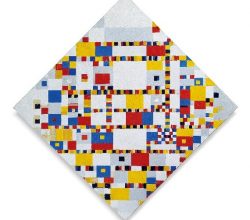
Art history sees Mondrian as an austere intellectual whose painted “pristine” abstractions. Well, perhaps he was livelier than that. He spent decades experimenting before producing his wonderful abstractions, so he knew about imperfection. In some paintings “his black lines break off abruptly … sometimes they are not even straight. And those planes of supposed white are, in fact, all manner of subtle shades”. His paintings, in the flesh, reveal Mondrian as “social, mortal and approachable”.
The Theology of Perspective

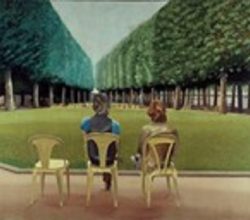
Hockney – he of the sunny swimming pools – has a serious side. He argues that western painting is too influenced by ‘linear’ Renaissance perspective. Cameras and camera-devices are to blame (excellently explained here) and it matters because a single point view doesn’t reflect our actual visual experience. For starters, linear perspective puts the viewer outside a scene whereas two-eyed viewers experience a scene from within. The “one-camera view of the world” Hockney says “can’t show you that much.

Candida Höfer composes staggering portraits of vacant public spaces

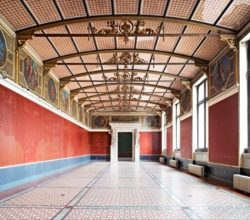
Höfer’s images have been criticized as being emotionless architectural photography. Yes, all her images are deserted building interiors – libraries, theaters, museums, opera houses. But emotionless? These are social spaces that, when empty, almost shout their expectations of their users. Says Höfer “What interests me is … what a space does to the imagination. What does the space intend? What did happen … how would I feel being in that space?” Images are here.

Neuroscience Gets in the Way of Appreciating Art

Some neuroscientists claim their science can explain our experience of art. What’s wrong with that? Plenty, says Noë, a philosopher. In the domain of aesthetic experience “there’s something intellectually bullying [when neuroscience says] “here’s the truth about you. There’s never any right or wrong way to see art. What I deny is that neuroscience is the aesthetic arbiter. Neuroscience thinks it’s doing science when really it’s participating in aesthetic conversation.”

Raphael, National Gallery review: ‘A show that adds heroic scale, bromance, even sex to effortless beauty’

It’s possible that Raphael’s “luminosity and clarity” and serene Madonnas mean he will never have contemporary resonance. But think of the big picture. A “master” painter at 17, then a noted portraitist in Florence, commissioned at 25 to paint the Vatican apartments, by his 30’s he had produced “some of the key works of the western tradition”. Even casual portraits of his friends have “breathtaking fluency”. More than enough to “run out into the street and shout “I love Raphael””.

Commission impossible: why galleries love buying ‘off the plan’

A newly expanded Sydney museum is on a “commissioning binge”. Why buy work in this way when the market for existing work offers a wide choice? Is the museum wanting to influence the type of work deemed “significant”? Artists are faced with a dilemma – is the money sufficient to endure having to accommodate a curator’s tastes? Such institutions are “no longer holding up a mirror of our times, but actively trying to stage-manage art history.”

5th April 2022

Anselm Kiefer: Pour Paul Celan

Paul Celan is widely considered the greatest postwar German language poet. Kiefer, the celebrated German-French artist, has long been inspired by Celan’s work and especially his renowned poem on death. In a recent show intended as a homage to Celan, the works carry the heavy overtones of war.  Says one critic, these are objects of “European memory”. Fittingly, they are sombre, incorporate materials such as ash and are “intimidatingly” large. They are “the past and the future linked by a vortex”.

Planetary Crisis? The Art Market Is Doing Just Fine

A bullish tone is struck in this year’s Art Market Report. Art sales reached $65bn in 2021, about the same as pre-pandemic levels (actually not quite, if adjusted for inflation). Online sales have doubled compared to 2019 while art related NFT sales show the influence of younger collectors. Art fairs have been hammered, which may please galleries and auction houses. Says the author, “the art market that has emerged from the pandemic no longer looks like the one that went in.”

Patrick Demarchelier, Fashion and Portrait Photographer, Has Died

Demarchelier was widely regarded as one of the greatest fashion photographers. Self-taught, he came to prominence working for Vogue and Harpers Bazaar, developing a signature style that “combined ease and elegance”. His celebrity portraits and images for magazines and fashion houses had an impact beyond fashion, embedding the supermodel in 1990’s popular culture. Such was his fame that in the movie The Devil Wears Prada, the lead character at one point shouts “get me Patrick”.

Pompeii in Color: The Life of Roman Painting

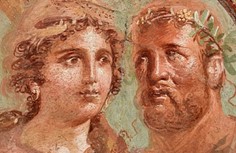
Pompeii was Rome’s pleasure dome – similar perhaps to the Hamptons in New York – with numerous lavish homes. Their frescoes, preserved by the ash of Vesuvius, were mostly decorative and reveal sophisticated Roman aesthetics. Besides landscapes and portraits there are still lifes and “astonishing trompe-l’oeil”. Ancient Greek art was a major influence, but these frescoes are “valuable creations in their own right”, authentic expressions of Roman culture.  Background is here.

The Whitney Biennial Falters On

Having skipped a year, the Whitney Biennial has returned. As usual, it focuses on what’s current. Leaning against the popularity of figurative work, abstract works are plentiful as is art coming out of #blacklivesmatter, and art still angry about the AIDS crisis. A notably diverse group of artists is represented. Wall labels, always a pet peeve, are often infuriating. This writer seems moderately pleased: “about 20 percent of the [show] is really alive … it radiates with the power of now.”

The Trouble With Writing About Vivian Maier

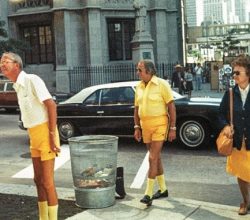
Vivian Maier is a riddle among modern photographers. While her day job was nannying for Chicago and New York families, she had a passion discovered only after her death – photography. Her images are so good that “if she’s not quite in the canon yet, she’s certainly wait-listed.” A new biography speculates that mental ill-health may explain Maier’s strange reticence. Let her keep her mystery, says the reviewer. Maier’s truth is in the “indelible images she left behind in those storage lockers.”

Takesada Matsutani On His Show Combine And The Power Of Material Experimentation

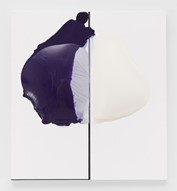
Japan’s gutai movement wanted to achieve “the scream of matter”. That meant exploring the expressive potential of materials – paint, tar, mud, glue, newspaper and more. Matsutani was an early member and, oddly, focused on what he could achieve with vinyl glue. Quite a lot, it turns out and his blobby works that straddle sculpture and painting have brought him acclaim. Even after a long career, though, he still feels bound by the same gutai challenge – “finding an individual approach”.