The Easel

29th March 2022

Why Francis Kéré Won the Pritzker Prize?

Architecture’s top honour – the Pritzker Prize – has always gone to western architects. Now, Kéré, from Burkina Faso, has won for projects built with cheap local materials and miniscule funding. He uses traditional designs and sees the architect as both designer and community organiser. Gushed the Pritzker Foundation, he is “a singular beacon in architecture… [His projects] have presence without pretense and an impact shaped by grace.” Says Kéré “I still don’t believe it”. Images are here.

Thomas Struth on four decades of art: ‘I know more, I see more, and I suffer more’

A New York show of Struth’s photography poses the question – why is his work so engrossing? For decades he has photographed mind-boggling scientific equipment, family portraits, empty streets and crowded museums. Some images are huge – metres long – and full of detail, hinting at some big but undefined issue. That is exactly Struth’s intent – “to address something which has a larger scale, a larger value, than the specific details or locations shown”.

“A Dyed-in-the-Wool Revolutionary Spirit”: Paul Gorman on the Legacy of Barney Bubbles

The highly influential designer, Barney Bubbles, is “grievously underappreciated”. He joined London’s fabled 1960’s music scene and, in the 1970’s, designed record album covers using an aesthetic that included geometric designs, brash colours and a subversive wit. While also creating light shows, homewares, set designs and video, his album covers are his most acclaimed work – “lasting images for fleeting times” and the “missing link between pop and culture”.  More images are here.

Ai Weiwei: The Liberty of Doubt

Is Ai Weiwei primarily an artist or a political activist? The linked piece inclines to the former, saying his current show illustrates that human experience is “as fluid as the meanings of these objects:  in a constant state of uncertainty”. Another critic definitely views him as an activist: “superficial art that we are urged to appreciate as “important” because of the artist’s unquestionably heroic political acts. [He is] better at throwing concepts in the air than clarifying what he means by them”.

Warhol-Prince Photo Case Brings Fair Use Fight to High Court

Cutting a long story short, Warhol altered a photo of the musician Prince. Years later, the photographer who took the images sued for breach of copyright, lost the case at first hearing but succeeded on appeal. The case is now headed to the Supreme Court. Did Warhol’s transformation “add new expression and meaning” to the photo? What makes the case so difficult is “the difference in legal thinking and art thinking”.  A whole genre of visual art will be impacted by the answer.

Surprisingly weird: why there is more to Raphael’s portraits than meets the eye

A big Raphael show opens shortly in London and this writer jumps in early to defend the artist. Once regarded with reverence, some now wonder if Raphael’s work is too perfect, “too melodious for our jangling times”. If you hold such doubts, look at his portraits. Often these were portrayals of friends and thus a “sanctuary” from demanding clients. These works best uphold his reputation, showing the very modern qualities of “human warmth and closeness”.

Will the new Burrell Collection give Glasgow global reach?

William Burrell’s donation of his magnificent art collection to Glasgow in 1944 was a great act of British philanthropy. Now, re-opening after a six-year renovation, how does the institution modernize the stories that its objects tell? Display works thematically, not taxonomically. Frame the collection as an expression of Burrell’s tastes, not an “impartial” story of civilization. And change the Deed of Gift so the Collection can lend works in order to borrow others.

22nd March 2022

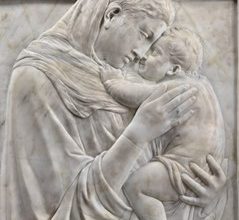
First major Donatello exhibition in nearly 40 years to open in Florence

Donatello, says the curator of a huge show in Florence, was “the greatest artist of all time.” Wow! He revolutionized sculpture by reviving the anatomical realism of the ancient Greeks. His bronze sculpture of David, an iconic accomplishment of the Renaissance, perfectly expressed the humanist view that the human form is inherently beautiful. Donatello’s sculptural vision influenced a later revolution in Renaissance painting and “reigned supreme until the arrival of Caravaggio”.

200 Priceless Paintings That Belong to Russia Are Stranded in Paris. Will France Give Them Back?

The priceless Morozov collection of modernist art, usually housed in Moscow, is currently on loan in Paris and due for return. How? All road and air links into Russia are cut. Seizure, as suggested in some French media, is “absurd” although, with emotions running high over Ukraine, who knows? With various art collaborations being cancelled, a Russian-born curator observes “a ban on loans and exhibitions will firmly close the door to Russian culture which will be very difficult to open again.”

Egypt & Africa at The Met

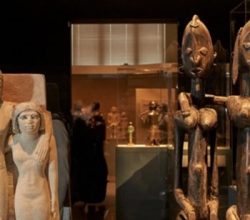
An exhibition of African art and older Egyptian art bristles with tensions. Were Egyptian culture and much later sub-Saharan African cultures part of one unified civilisation? Should colonial plunder be restituted? No wonder the critics disagree wildly. The show “fails” on visual and historical terms, says one. Another describes it as a group of “displaced masterpieces”. A third says “beautiful”. There is a consensus of sorts, though, that art from sub-Saharan Africa has “head-turning, eye-locking beauty”.

Artist Gerhard Richter at 90

Richter’s storied career is marked by frequent stylistic “disruptions” – abstractions sometimes, but then realist images or landscapes. One reviewer describes his birthday show in Berlin as “tough going”, perhaps not surprising given Richter’s view that “pictures that are interpretable and that contain meaning are bad pictures.” His biographer claims, “Richter rescued painting in the 21st century”. The linked piece is biographical; a good survey of his art is here.

“Picasso: Painting the Blue Period”

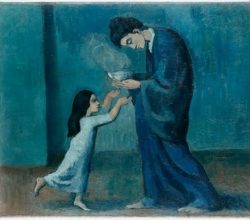
Apparently there is more to know about Picasso! From 1900, he was deciding his career direction and the Blue Period works show these deliberations. A nude seems to reflect Rodin. His Blue Room is linked to Degas and Toulouse-Lautrec. Portrayals of women in poverty owe something to Spanish religious works, Mary Magdalene figures “trying to reach out past suffering and toward redemption.” By 1904, Picasso had come to peace with these torments and moved on.

Signs and meaning in the work of Robert Indiana

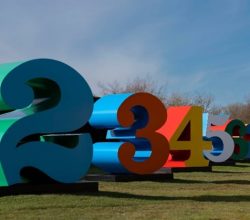
Indiana’s L_O_V_E sculpture is so ubiquitous that it draws attention away from his other, more complex works. During childhood, his family travelled constantly, leaving him with a love of numbers and signage. Later, in New York he used scavenged wooden beams to make pole sculptures that “explored the busted flush of the American dream”. These more personal pieces provide unexpected depth of meaning to Indiana’s “often exquisitely beautiful works”. More images are here.