The Easel

8th February 2022

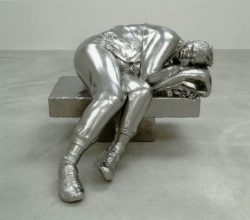
Is acclaimed sculptor Charles Ray losing his magic touch?

Ray has had earned many accolades for his sculpture, including a current retrospective. It features the kind of work that has brought acclaim – “conceptually teasing” hyper-real tractors, cars, reclining nudes, done in a variety of materials and immaculately finished. Except, there is a “disjunction between intention and effect … what is horribly unclear is why we should care. Many pieces, for all their shininess, look as lifeless as ash”. Images are here.
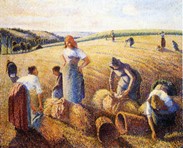
Camille Pissarro: The Studio of Modernism

A Basel show makes the case that Pissarro was the nerve centre of Impressionism. His influence was widespread – painting and drawing with Cézanne and others, collaborating on printmaking, lending his support to Seurat and pointillism. He was “a catalyst bringing together the various vectorial forces” behind modernism. Paris-based artists were unpersuaded by Pissarro’s anarchist beliefs and blunt portrayal of rural labourers. But that style too won fans – among the social realists of the Soviet Union.

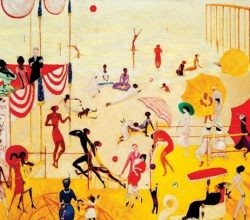
Florine Stettheimer: A Biography

Although she exhibited regularly, Stettheimer never joined a gallery and resisted selling her work. Little wonder the art world forgot her. A biography is evidence of renewed interest. Her theatrical style, perhaps sparked by Diaghilev’s Ballets Russes, was seen by some as flippant. A closer examination reveals her work as complex, full of a “cagey kind of politics” that is expressed through “murmured satire”. Says the writer “a quintessentially modern artist”. Images are here.

A Look at the Wallace Collection, Yesterday, Today, and Tomorrow

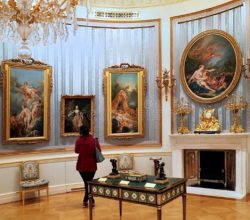
The Wallace Collection bequest is probably the most valuable such gift Britain has ever received. That makes the collection a story in itself. Five generations of the family used their wealth to build an immense art collection – Rembrandt, Rubens, Velazquez, French Rococo paintings galore, galleries “full of grand stuff”. The Collection has recently started loaning works and has a plan to “transform the visitor experience”. Says this US writer – “Perfection is never transformed for the better.”

Jeff Wall with Barry Schwabsky

Amidst a flurry of shows, Wall discusses his acclaimed “staged” photography. From the outset, he was attracted to artifice, something photography had long rejected. And he sensed that making his images large was a “central” step because big pictures are “a more physical way of capturing your imagination”. With these elements, Wall happily calls his approach “cinematography”. Just don’t conflate that with the cinema – “They’re really not the same thing.”

Edmund de Waal: Lettres à Camondo

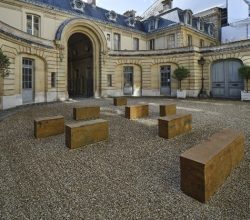
Rarely is the venue of an exhibition as notable as the exhibition itself. Musée Nissim de Camondo in Paris was originally the opulent home of a Jewish banking family. Having donated it to the state as a museum, they later perished at the hands of the Nazis. A show of de Waal’s ceramics in the museum is “an exercise in restraint” with simple bowls, slender vases, thin slithers of porcelain alluding to the family’s tragedy. Stone pieces in the courtyard, says de Waal, are “markers of loss and repair”.

1st February 2022

Robert Gober’s Mirror

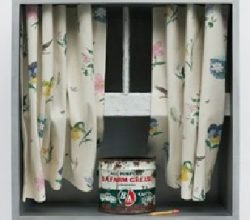
Gober’s sculptures of chairs, sinks, legs and more are meticulous, “hyperhandcrafted” as the writer puts it. Why such effort? Careful fabrication makes these objects that we all use seem precious, worthy of our close attention. But then, some details are awry – old windows, for example, that have the curtains hung wrongly. All this helps explain why Gober’s sculptures are acclaimed. They connect us, says the writer, to “something bigger … a promise of new beauty.

Allison Katz, Artery, review: a zany show that puts the mischief back into painting

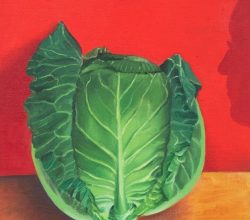
When a new artist gets their first solo show, critics try to spot the artist’s ‘theme’. Katz, at her first major solo show in London, seems to have everyone stumped. Some of her paintings are full of “trickery” – word puns, visual illusions. Others feature cabbages, cockerels, or open mouths. “There is no grand theme or statement’ concludes the writer, just an artist considering the conventions of painting … and producing work that is “continuous fun”.

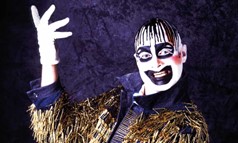
Retrospective for performance artist, arch provocateur and 80s club kid Leigh Bowery hits London

If Yves Saint Laurent has a place in the art world, so too does Leigh Bowery. It’s just hard to name that place. Bowery was prominent – monstrous – in 1980’s London, in fashion, dance, club, music and art, famously inspiring portraits by Lucien Freud. His most obvious legacy is the wild creativity and street/club culture he brought into fashion. A rock star of that time called him “modern art on legs”. Of himself he said, “if you label me, you negate me”. Images are here and a bio piece here.

Made In The Dark Room: Roy DeCarava Captures Mid-Century New York

After trying to be an artist, DeCarava switched to photography. Success came very quickly and his images of 1950’s Harlem – the Harlem that he knew – are still remarkably fresh. Jazz clubs were a favourite haunt and their smoky low-light ambience suited his aesthetic perfectly. If necessary, he processed his images to darken them – “not quite black and white, more tones of grey … His images can seem teased out of the darkness”. More images are here.

New galleries of Dutch and Flemish art

Art history has thought the Dutch Golden Age spectacular – superstar artists and a tolerant civil society. Such ideas are now “dead”, replaced with a more realistic narrative about slavery, colonialism and class conflict. How should a museum tell such a radically different story? Very carefully, that’s how. Donor sensitivities abound, as do the expectations of museum visitors. Challenging “received opinion” is a core task of museums and such debates are the “mechanics of museum-making itself”.

Tauba Auerbach: the gift of intellect and its boundaries via new exhibition “SvZ” at SFMOMA

Science has a certain romance because it’s where we touch the unknown. Auerbach has spent her career expressing scientific ideas – and the limits of our understanding – in art. Some find her “deeply inquisitive” work tough going, “Uncompromisingly abstract” says one writer. Another grouches that it’s “both too arcane and oversimplified”. Expressing maths through art is daunting, but Auerbach’s work captures the feeling that, when faced with the unknown, “we crave answers”.

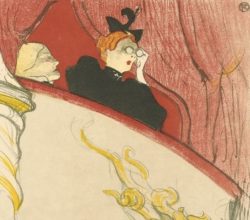
‘Hue & Cry’ at the Clark explores controversy of color printmaking in 19th-century France

Printmakers in 19th century France avoided colour printing because it was emblematic of “banished [aristocratic] excess”. By 1870 advances in lithography made cheap colour printing possible, attracting artists like Cassatt, Chéret and, of course, Toulouse-Lautrec. A world first had emerged – “bona fide mass-market art”.  Acceptance into the 1899 Paris Salon brought recognition as fine art. That cost posters their transgressive character and slowly, the art market lost interest.