The Easel

8th September 2015

JH Pierneef’s people-less power

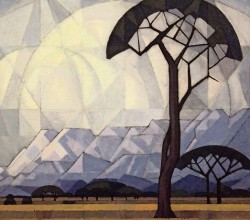
A great piece of writing. JH Pierneef was an iconic twentieth century South African landscape painter. A current exhibition of his work – the first since the end of apartheid – is being acclaimed, but there is a problem. Pierneef was very active in the movement that inspired apartheid. Should this exclude him from that nation’s cultural lineage? Further images and a less politically concerned review, is here.
Siena’s Duomo unveils its mosaic floor

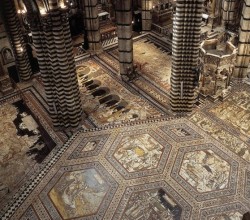
Once the residents of Siena are done with their famous horse race (the Palo) they have a scarcely less spectacular event – the unveiling of the cathedral’s inlaid marble floor. Completed about 500 years ago, the floor depicts over fifty biblical scenes and is among the most ornate in Italy. It is usually covered up for protection but is on view now for just the next month. More images are here.

Does Looking at Art Make You Smarter?

A new book reviews long term field research about the effect of creative activity on thinking. ““What we think of as representational art is pretty abstract”… having the ability to see an image in two-dimensions as a representation of an actual thing in three dimensions takes a level of abstract thought that, say, your cat doesn’t have”. An interview with the author is here.

Total Surface: Barnett Newman’s Late Work / Interviews with Michelle White and Bradford A. Epley by David Ebony

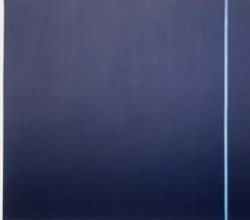
Barnett Newman believed that his paintings with their vertical “zips” were epic.  Some critics at the time agreed and, as the curator of a recent show comments, the paintings do “[push] you out and into your own physical space [when standing] in front of the work”.  But critical ardour has perhaps cooled with time. Grumbled Robert Hughes, Newman’s colour field style “encouraged a phony grandiloquence”.

J.P. Morgan: The Man Who Bought the World

Art collecting was one of John Pierpont Morgan’s great passions and he did it on a vast scale, “travelling in a cloud of experts, dealers, and antiquarians”. That his will failed to spell out who should get what seems significant – “almost a recognition that art objects are objects caught for a little while in a cabinet of curiosities or a drawing room or a picture gallery, before they move again”.

After Utopia

Singapore has the reputation of being an efficient city state, so it is mildly surprising to hear about the emergence of a vibrant art sector. The Singapore Art Museum (SAM) focuses on contemporary South East Asian art and has a mission to “make infinite room for everyone to think, feel, experience and imagine”. A nice idea, even if it is not yet fully reflected in Singapore’s own community life.

Emerging from Ai Weiwei’s shadow: China’s new art

The newer generation of Chinese artists that is following Ai Weiwei were not as directly impacted by the trauma of Tiananmen Square. Neither have they faced the challenges of a poor art education system and the absence of a functioning art market. “Much of [their] art … is unapologetically “lite”… Yet this seeming banality often belies deeper concerns with the state of affairs in contemporary China—and the world at large”.

1st September 2015

Life Lines: Portrait Drawings from Dürer to Picasso at the Morgan Library

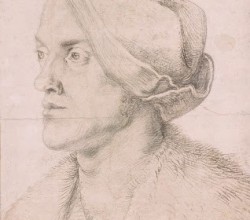
In the endless debate over the importance of line versus colour in art, an exhibition at the Morgan Library and Museum tips the scales toward the former. One critic gasped about a Durer portrait, drawn almost 500 years ago “as compact as a Brancusi sculpture, an audaciously abstract compression of solids and voids”. This reviewer is equally forthright: “Drawing is the foundation, the one indispensable prerequisite, of all great art.”

Mom’s Home

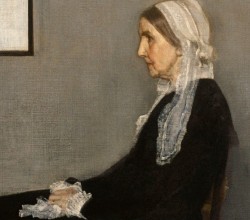
What is she thinking? Whistler’s 1871 portrait of his mother, “the most important American work outside the US”, was done seven years after she went to live with him in London. After an elegant consideration this reviewer’s concludes “[His mother’s] blank forbearance speaks of capitulation. She will do anything for him. She is his.”

A Nerd’s Guide To The 2,229 Paintings At MoMA

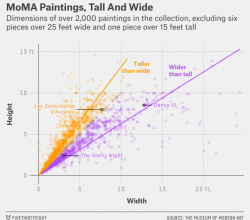
Some light-hearted numbers. A newly public database of MoMA’s paintings has been analysed by a renowned statistician and political analyst. “Oil painting … still dominates in the modern era [47.5% of the collection].” “[T]he average acquired painting was painted about 30 years before it joined MoMA’s collection.” “There are 956 paintings that are wider than they are tall and 1,079 that are taller than they are wide. There are 131 square paintings.”

Edinburgh Art Festival, review: ‘hit-and-miss’

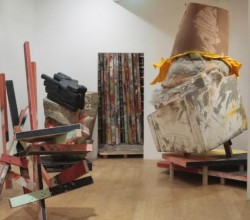
Phyllida Barlow has never felt drawn to British sculpture’s “moral tradition” – the beautifully crafted works of Moore and Hepworth. She prefers humble materials – timber offcuts, cement, foam – to create monumental sculptures with both presence and intimacy. “On one level, it is chaotic in a preschool way [but] has sufficient heft and intrigue to remain compelling”. An excellent video about her 2014 Tate show is here.

One of the world’s most respected curators vanished from the art world. Now she wants to tell her story.

The wealthy J Paul Getty Museum is surely an ambitious institution. When one of its curators was charged in 2005 with buying looted art, it was a big story. In court the case against Marion True failed and her story is one where bright moral lines are not always easy to find. “Unprintable words fly. Tears well up…. [Getty staff] acted as if I had done all this stuff on my own, which would have been impossible to do”.

EXHIBITION ROUNDUP: “CHINA 8”

Given the large number of newer Chinese artists, inclusion in exhibitions sometimes defaults to auction room profile. This exhibition, coordinated across nine German museums, avoids this risk by virtue of its scale – 500 works by 120 artists. That makes it not only a notable event for Chinese art in Europe but also an important opportunity to see new names in context.

Review: Elaine Lustig Cohen’s Paintings Move Into Philip Johnson’s Glass House

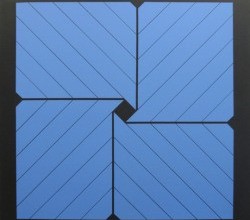
Elaine Lustig Cohen never thought of being an artist until the architect Phillip Johnson offered her a design brief. Thus began a long career straddling graphic design and painting. So, has the inspiration she drew from architecture led to great paintings? “Somewhat second string” according to the writer. Her paintings use a vocabulary “intended for other disciplines and purposes … book covers and … corporate logos”.

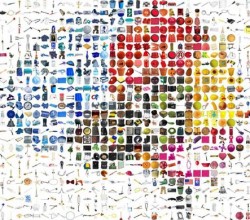
Image: Google