The Easel

19th September 2023

The deadpan precision of Ed Ruscha’s L.A. sensibility

What is it about Ruscha’s word paintings? Their lineage goes back to Picasso and Braque who put advertising text in their collages. Ruscha’s works feature deadpan phrases plucked from the “clamour of American life”. Sometimes, their meaning is so literal, so obvious, that the viewer doubts themselves. Such works are like “billboards that are empty of sentences but have plenty to say.” Little wonder the writer calls Ruscha the “genius of Pop Conceptualism”.

Why is Frans Hals still not considered the equal of Rembrandt?

In advance of a major London retrospective, an enquiry into the artist. Hals portraits are acclaimed, argues a curator, for how well they characterize people – less psychological depth but tremendous relatability. So why is he usually ranked below Rembrandt? Hals specialised in “the group portrait. You have to look carefully to see their brilliant naturalness, [but] the spontaneous becomes habitual … you need variety of subject to be a great painter.”

Fernando Botero dies at the age of 91

Botero, widely acclaimed in Latin America, found more stinting praise elsewhere. For years, critics wrote negatively about his corpulent figures. “I am interested in volumes” he responded, “the sensuality of form”. His images undoubtedly have a lighthearted side but a series of works in 2005 depicting torture in the Abu Ghraib military prison forced an abrupt, positive reassessment. He was, it was acknowledged, a “deft observer”.

Is Keith Haring’s Art for Everybody?

Haring’s graphics were so effective that, decades later, the style he developed is integral to our visual environment. He saw no fixed meaning in his own work, believing instead that art is inherently social. His immense influence owes much to self-promotion, his egalitarian media – subway drawings, for example – and the “strength” of his line. Says the writer, “ the enormity and impact of Haring’s output is awesome … never boring”. Images are here.

Albrecht Dürer’s genius for self-promotion

A book on Dürer tells the tale of an altarpiece that he was commissioned to paint. It turned into a battle between a filthy rich patron and Dürer, “one of the most narcissistic artists that ever lived”. Part of what makes the story memorable is its context – dynamic Northern Europe, pressing its claims for artistic ascendancy over Italy. Further, Dürer and his buddies were pioneering the commercial art market. He was, says one writer, “the first truly international artist”.

Hitler’s bronze stallions unveiled in Berlin

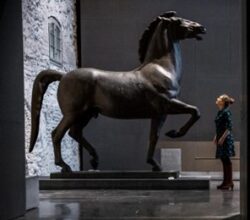
After 1945, Nazi sculpture was mostly destroyed, stolen or hidden in storage. Hitler’s massive “Striding Horses” disappeared in that year but were dramatically recovered in 2015. Now restored they are being unveiled in an exhibition of “problematic” art. The organisers, who aim to specialize in “toxic” art, described the show as an opportunity to “come to terms with the great symbols of National Socialism”.  As for the sculptures, they “radiate a certain violence”.

Find six similarities between these two paintings by Picasso and el Greco

The Spanish distained El Greco. The young Picasso (among others) disagreed. His early work was clearly influenced by the 16th century master as well as, it is argued, his seminal cubism. El Greco, with his distorted figures and unreal colour choices, prioritised the psychological over the literal. Analytical cubism similarly used geometric fragments to create a 3D impression of an object in 2D. Says one curator “To me, Cubism seems to have been born with El Greco”.

29th August 2023

Easel Essay: Borromini – mystery man of the Baroque. Jed Perl and Deborah Rosenthal in conversation with Morgan Meis

Borromini has long been overshadowed by his illustrious contemporary, Bernini. Some years ago writer Jed Perl and artist Deborah Rosenthal spent time in Rome and became fascinated with Borromini’s work. In a new book – a “duet” of prose and prints – they sing the praises of this mystery man of Baroque Roman architecture.

“Their distinct but related styles – Bernini’s thunderous, Borromini’s musical – defined the dynamism of the Roman Baroque style. Borromini [focused on] the productive synthesis of opposites. People invariably point to the plainness of his churches, which have none of the elaborate, sculpted and painted figures that dominate so many Baroque buildings. Yet, 350 years later, his work seems the more modern achievement.”

Kehinde Wiley is selling kitsch

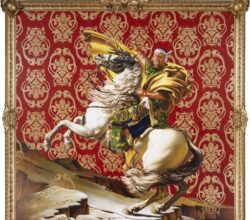
Wiley’s show An Archeology of Silence is a big hit, further increasing demand for his work. To cope with these pressures, the artist has a streamlined production system. This seems not to have helped his art. “The exhibition is … pure kitsch. Kitsch is rooted in emotional cliché … and [presumption]. The presumption is that everyone feels the same way as you. His works offer none of the pleasures and surprises afforded by good painting. Their surfaces are immaculate … and utterly dead”.

The Art of the Mug Shot

Leaving the politics aside, former President Trump’s jarring mug shot illustrates the power of an image. Mug shots traditionally provide entertainment and, with their harsh lighting, a measure of humiliation. This one also conveys belligerence and agency in a situation where normally there is none. Surely that took a great deal of practice in front of a mirror. Sales of Trump merch are already benefitting. Will it be the image of the year? Very likely.

Ick Art: Why a Rising Generation of Female Sculptors Is Embracing Body Horror

Describing Lee’s work as “kinetic sculpture” is way too polite. She uses motors, scaffolding, fabric and hoses to create bizarre organic systems that slop, squish and drip goo. It’s “a bit grotesque” she admits, identifying one inspiration as the desire to devour or be devoured. Where are we going here? Her objective is to create art that makes us feel, not think. One critic calls her work “unflinching”, another says it’s “not pleasant and certainly not nice. But it works.”

British Museum’s director resigns, says he didn’t take warning about possible theft seriously enough

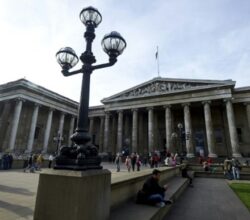
The British Museum Director has abruptly resigned due to the multi-year theft of over one thousand precious items. The story has the usual elements – incompetence, complacency and whistleblower abuse. Much more consequentially, the debacle erodes the Museum’s assertion that it is an exemplary custodian of cultural treasures. That capability has been a key argument in its refusal to return the Parthenon Marbles and other colonial-era treasures.

The Problem of Art Without Men

The first time London’s National Gallery gave a solo show to an historical female artist was in 2020! It’s amazing facts like that that make Hessel’s book on women in the history of art such a revelation. Many examples of erasure are detailed – misattribution being suspiciously common. Hessel’s bigger argument is that “the story of art would not be the rich, eclectic, challenging one we know today if [the making of the art] had been reserved solely for men”. An interview is here.