The Easel

21st February 2017

Celebrating Design Without Contending With It

Netflix is launching a docuseries that tries to answer the question “what makes good design?” One designer suggests empathy. “Design is not just a visual thing. It’s a thought process. Ultimately, design is a tool to enhance our humanity. It’s a frame for life.” But the creator of a docuseries on design prefers something less lofty: “I described design to somebody as art with clients.”

Image: Netflix

Never mind the politics, feel the lobsters – Wolfgang Tillmans 2017, Tate Modern

Tillmans came to fine art photography from fashion. His images are contemplative and patient, not at all the photography of the ‘decisive moment’. So, what is his defining quality? “[H]is instinctive knack for creating memorably ravishing images is a sort of ocular superpower – the essence of his talent, akin to, say, David Hockney’s exquisite draughtsmanship.”

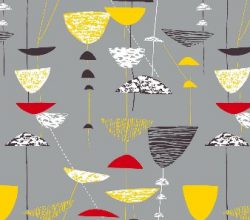
Power and originality: the iconic print designs of Lucienne Day

Post-war Britain wanted colour and style and textile designer Lucienne Day was the one to supply it. Her “resolute modernist” designs, drawing in particular on the visual language of artists like Klee and Calder, were both popular and influential. Later work included carpets, ceramics and aircraft interiors.  Notably, most of her work was aimed at the mass market: “She made the link between mass production and fine art.”

Man Meets Machine: Eduardo Paolozzi at Whitechapel Gallery

As English critics are quick to remind us, Paolozzi was there right at the dawn of Pop art. But he moved on to other things – many other things. Reinvention is probably a good thing but in Paolozzi’s case was there sufficient quality control? “His driving interest — the relationship between man and machine — feels dated … His later works … are hideous and over-obvious.” More images are here.

Image: Whitechapel Gallery

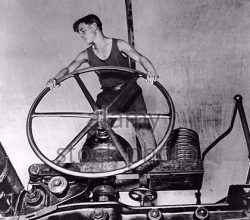
Revolution: Russian Art 1917-1932, Royal Academy

“Most depressing exhibition ever” is not a promising start to a review. Russian art in the 1920’s was enthusiastic about the revolution until a 1932 edict closed down all art except socialist realism. Can the early art be separated from its politics? For some yes, but not for this writer “The role of tendentious images like these was to divert people’s attention from dismal reality … propaganda at its most leaden”.

The Red of Painters

Red carries a long cultural history. Medieval recipes for making red pigment make clear that “one could not do just anything with anything: vegetable was pure, animal was not; mineral was dead, vegetable and animal were living. [O]ften the essence of the operation consisted in making a material considered to be alive act upon a material considered to be dead: fire on iron; madder or kermes on aluminum salts; vinegar or urine on copper.”

Jannis Kounellis, Whose Ingenious, Poetic Work Helped Define Arte Povera, Dies at 80

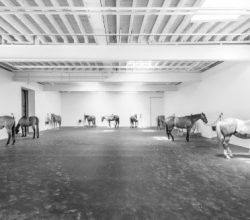
Although trained as a painter, Kounellis quickly made his way to working with found objects including burlap sacks, coal, smoke, shelving units, trolleys and coffee grounds. Most famously, he once tethered a dozen horses inside an art gallery, leading this writer to observe “As is true of so much of his work, it was both utterly beautiful and utterly strange”.  A review of his last show in Rome is here.

Image: Gavin Brown’s enterprise

14th February 2017

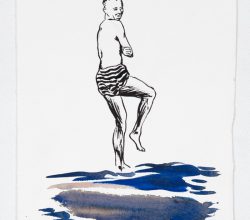
From Black Flag to Charles Manson, Raymond Pettibon’s New Museum Retrospective Has Something for Everyone

Right from his youth Pettibon has drawn. His images seem straightforward but become ambiguous with the addition of snippets of text. Those snippets are “as researched and studied as the drawings themselves”. Often they convey social criticism – is there a unifying theme? Is it “the dissolution of American idealism”? asks one critic. The writer identifies another source of ambiguity – “Who is speaking in this work?

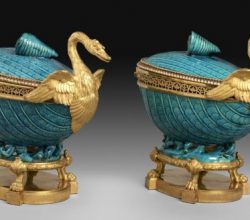
Pierre Gouthière: Virtuoso Gilder At The French Court

Decorative art gets a moment’s prominence with an exhibition of the work of eighteenth century French gilder Pierre Gouthière. He enjoyed contemporary acclaim for his extraordinary gilt-bronze creations but then along came bankruptcy and the Revolution. “Ultimately [Gouthière’s works] are not stereotypes, they are not archaeological at all, but … a close look at nature.” More images are here and a video (11 min) on his techniques here.

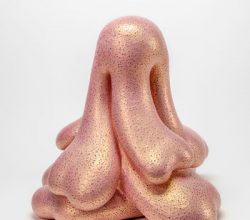
Ken Price: “A Survey of Sculptures and Drawings, 1959 – 2006”

It is perhaps an indicator of the changing status of ceramics that American ceramicist Ken Price is now sometimes referred to as a sculptor. Influenced by Los Angeles’ commercial art, he subsequently explored artisanal Mexican pottery. He is best known for his abstract shapes and a characteristic work method of painting unglazed fired clay. Background on the artist is here.

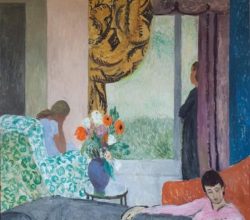
Atmospheric insights into a world of privileged bohemianism – Vanessa Bell, Dulwich Picture Gallery, review

Vanessa Bell was a core member of the famous Bloomsbury group of intellectuals. Mid-career she was at the forefront of the English response to European modernism. However, her profile as an artist remains low – she is more famous for the company she kept. Conceding that some of her works are strong this writer nonetheless is unimpressed: “her work is essentially derivative”.

A Painter of the Shattered World

Paul Nash seems to present to English art critics as a mystery to be solved.  First and foremost he was a painter of the English landscape. But the blasts of modernism from Europe clearly impacted his work. Were his strange landscapes different enough to be called avant-garde? Perhaps not. At career’s end we see “less Nash the pioneer [and more] Nash the painter of an odd, spiritualized, peculiarly English countryside”.

Ignore the art market – there is only one Bruegel that matters

The UK discovery of a work by Brueghel the Younger has been widely reported. But how much fuss should be given to a work that the artist painted 31 times and copied from his genius father (Bruegel the Elder)? Does the market understand the difference between father and son?  “Brueghel the Younger is not a great artist: There are so many [of his] works … lying around in stately homes [for] a keen market [to] draw on”.

Image: Holburne Museum

Who was the real Victor Pasmore?

How do you characterize a painter who cycles through nearly every style? Pasmore started off as a “sort of Impressionist” but then journeyed through cubism, Old Masters realism, romantic landscapes … and abstraction. Pasmore himself didn’t identify with any particular style – “I call it … art that is independent like music.” But critics love to categorise: “he was at his peak … between figurative art and abstraction.”