The Easel

7th February 2017

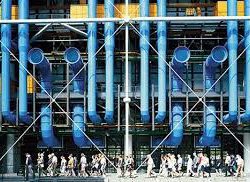
The Art Machine: The Centre Pompidou at 40

The Pompidou has been hugely successful.  Its radical design, coming from then unknown architects, yielded a highly workable building. Further, its “genius” first director created a defining inter-disciplinary programme. Perhaps most importantly, its aspiration to be accessible to the general public has worked. Perhaps too much: “[we want] openness and accessibility … but we also have to defend more and more the silence.”

At the Fondation Louis Vuitton

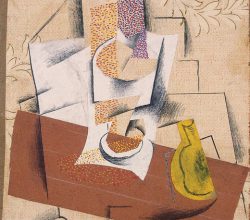
The Shchukin collection currently showing in Paris has multiple back stories: “frenemy” collectors, friendships with famous artists, inspired choices (51 Picassos) but puzzling omissions (1 Braque). Its dazzling quality prompts an imponderable question: “What must it have been like … to have been that collector, with that money, in that Paris, at that time – that short, brilliant period of European art?”

Jimmie Durham’s art throws some well-aimed stones

After art school Jimmie Durham gravitated toward theatre but got side tracked into the movement for Native American rights. Ambivalent toward his homeland he moved to Europe where he is now widely recognised. At his first major US show in decades, issues of identity are still an animating force in his art. And what is that identity? I am, he declares, “a full-blooded contemporary artist, member of the tribe of sculptors.”

The Joy of Eighties Art

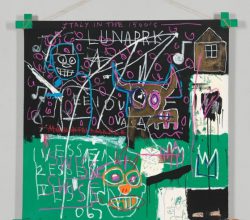
Minimalism ruled the New York art scene for a decade but by about 1980 it was time for change. A variety of sensuous, cheeky figurative artists came to the fore, along with the first influx of big money.  A further decade along, AIDS had sapped the energy of this moment. The 80’s style of engaging the viewer with “stroke by stroke intimacy and nuanced elegance” yielded to Jeff Koons cool sculptural installations.

Image: Whitney

Bauhaus Masters Josef and Anni Albers Obsessively Collected South American Art

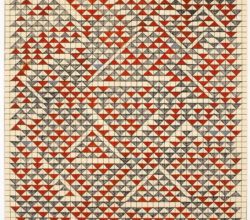
Is Bauhaus design and pre-Columbian art such a strange coupling? Both Albers taught at the Bauhaus. After emigrating to the US, Latin American art strongly influenced their work– he in colour theory, she in textiles. “For the Albers, art and the visual had to be everywhere in your life, and in Mexico, art was everywhere. They felt that people there were living with visual flair … which was the dream of the Bauhaus.”

The Late Flowering of Rose Hilton

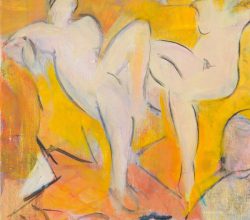
Rose was married to Roger, a famous artist but also a domineering alcoholic. Any painting she did had to be done in secret. She reflects “I was possibly of that generation where women gave in to their man.” Since his death there has been a “dam burst of creativity”. Her earlier abstractionist style now often gives way to figuration. Gallery representation arrived late but since then multiple shows, a retrospective and now a biography.

As Top Tier Artists Age, the Art World Hopes to Cash In

With the escalation in art prices the estates of some artists are worth millions – or even billions.  Who will manage their estates? The big auction houses, galleries and art consultancies all have ambitions and are busy tweaking their business models to exploit this new line of business. As a Sotheby’s executive comments “We are not an auction house; we are an art business”.

31st January 2017

David Hockney and the joy of looking

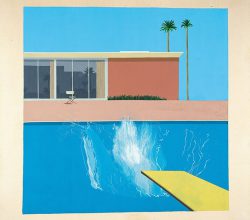
When critic Clement Greenberg said “it’s impossible today to paint a face”, de Kooning responded “that’s right, and it’s impossible not to”. Hockney, sympatico with de Kooning, has stayed true to figuration all his career. Tate opens a retrospective next week, marking the artist’s 80th year. For this writer his career hallmark is a “commitment to the present moment, and his [communication] of sensations and emotions.”

After the Great Flood of Florence

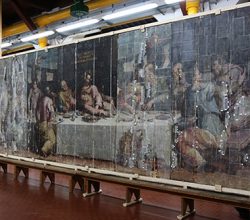
When Florence was flooded in 1966, Vasari’s Last Supper was one of thousands of paintings damaged. Considered at the time a lesser work its restoration was put at the end of the queue. Just as well – it has taken 40 years for the requisite technology to arrive. A workshop official said “This is probably the only place where you can expect a miracle”. The painting, now re-hung, features in this excellent video (8 min).

Image: Getty Foundation

The Shape of Things: Photographs from Robert B. Menschel @MoMA

A standard review of this exhibition is here but the linked piece (“Comments”) goes off on a tangent. “[H]erein lies the challenge. For a collection [assembled by a person] to truly sing, it often needs to show off its unabashed individuality, but once firmly placed inside an institutional context … it must do the exact opposite, stripping away all its vestiges of personal charm and resonance in favor of arm’s length art historical objectivity.”

Image: MoMA

Why Christo Cancelled an Epic Public Artwork

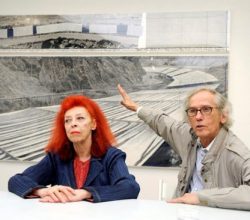
In a protest aimed at newly elected President Trump, installation artist Christo has cancelled plans to drape a canopy over six miles of Colorado’s Arkansas River. Project planning has taken over 20 years and consumed $15m but Christo deems the effort not wasted. ”[H]e identified public debate as vital to art—much more so than the installations themselves”. Varying local attitudes are reported here and project images are here.

Image: Denver Post

Getty Museum presents first major exhibition on 18th century artist Edme Bouchardon

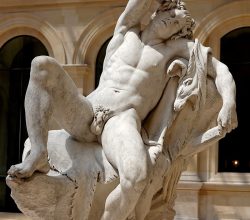
Little known Edme Bouchardon was the pre-eminent sculptor of 18th-century France.  But royal patronage didn’t alter the fact that he was more admired than popular. A taste for naturalistic design sometimes jarred with a court that preferred rococo. As a result a limited number of commissions were finally realized. Those that were are ravishing as are his brilliant drawings.

Elementary My Dear: Michael Andrews At Gagosian

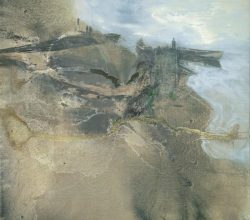
By the time critics started talking about a “school of London” in the mid 1980’s Andrews had left figurative painting (and London) to his more famous pals. He turned to landscapes and produced works that had a contemplative or religious quality. But he produced few of them: his friend Frank Auerbach observed “he is a painter who only paints masterpieces”. An excellent video (9 min) is here.

Feel-good fractals: from ocean waves to Jackson Pollock’s art

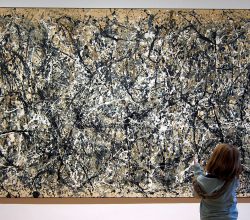
What explains the mesmerizing effect of Pollock’s drip paintings? A physicist (and amateur photographer) has found that these works contain repeating (fractal) patterns. Further, the ratio of big features to fine details in Pollock’s work falls exactly into a psychologically “preferred” range. What this may mean for “fractal free” art – minimalism, Rothko, pop, and more – will presumably be explained to us in due course.