The Easel

22nd November 2016

Elton John’s Radical Eye

Tate Modern admits it only began collecting photography seriously in 2009. Local celebrity Elton John is helping out by loaning them pieces from his collection. Many reviewers struggle to focus on the works rather than their owner. But, there is agreement that his is a collection of the highest quality – and the Tate show is too, borrowed though it may be. Images and a video interview with the collector (4 min) are here.
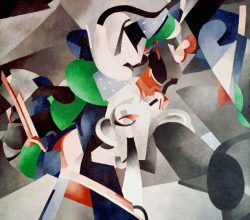
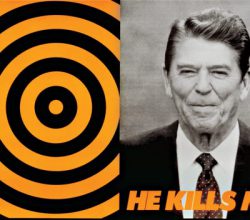
Monster Mash: MoMA’s Retrospective of the Shape Shifting Provocateur Francis Picabia is one of the Best Shows of the Year

The current Picabia show first opened in Zurich because of that city’s links with the Dada movement. Now in New York, the show is viewed somewhat differently through American eyes. Lesser emphasis on Picabia’s Dada links brings other aspects of his profoundly innovative output into focus. Like his habitual rule-breaking: “I would argue Picabia never quite painted a masterpiece … and suspect that he would take as a compliment.”

This Post-Election Pain Is Good, At Least for Art

Ripples from the election of Donald Trump are everywhere. Jerry Saltz responds with a call to action. “[T]he shift or clusterfuck under way may … return [professionalized artists] and all of us to our rightful outsider gypsy position — aristocratic bohemians with highly calibrated bullshit detectors. After all, why should art want to serve consensus? What is interesting, or exciting, or urgent about consensus? ”

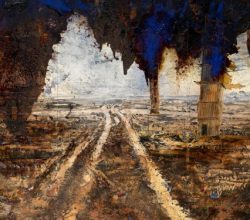
‘Walhalla’: Anselm Kiefer, White Cube Bermondsey

Among German post-war painters it is Kiefer who has won particular critical acclaim. His ever-present theme is the tragedy and hope of German history, tackled with a style that one critic described as “grinding earnestness”. His current show contains huge canvasses encrusted with the unconventional; “clay, ash, earth, lead, and fabric”. Important? – yes; challenging? – yes again.

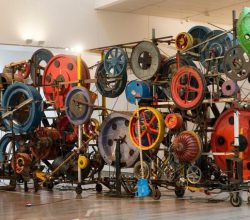
Jean Tinguely: Machine Spectacle

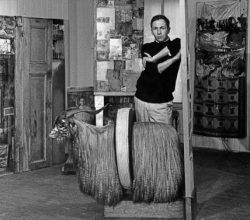
Tinguely said he couldn’t tell when a painting was finished. So he switched to making machine sculptures, their movement offering him “an endpoint”. He viewed his weird contraptions as fun that shouldn’t be in museums. Some he even designed to self-destruct. Now, they define his legacy. Those that have survived are treasured objects and mostly kept … in museums. An excellent video (7 min) is here.

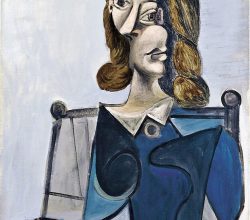
Picasso Portraits at the National Portrait Gallery is an interesting but perverse and surprisingly limiting exhibition

Who is not in awe of Picasso’s virtuosity? But the writer poses an interesting question. These portraits may be great paintings but are they great portraits in the tradition of Velazquez or Rembrandt? “It would be hard to claim psychological depth or exploration of character; Picasso was interested in subjecting his sitters, sometimes almost obliterating them, under the force of his pictorial design.”  More images are here.

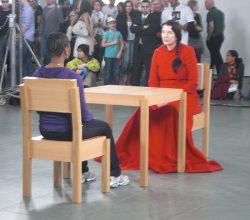
What Makes Marina Abramovic’s Art So Extreme?

Marina Abramovic is a pioneer of performance art with a substantial reputation and an outlook on life that is, well, different. One reviewer of her “misconceived” memoir notes the need to tolerate “a certain amount of pomposity”. A colourful example of how her book can be viewed in the absence of such tolerance is here. A (serious) interview with the artist can be found, of all places, in Harvard Business Review.

Image: Wikimedia

15th November 2016

EASEL ESSAY: Andrew Wyeth, his Critics, and Small Town Mud

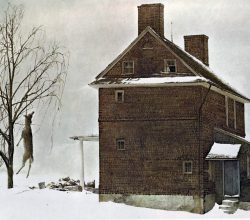
Andrew Wyeth might just be America’s most popular painter. People feel at ease with his work. It seems straightforward, depicting rural and small town scenes that figure large in America’s yearnings about itself. But contemporary critics were not enthused and little has changed since.

Well, the critics should look more closely, argues Contributing Editor Morgan Meis. Wyeth’s favourite subject was indeed small town America. But he wasn’t trying for nostalgia or homey. Rather, he was seeking to tap into the particular psychology of that world, the mood of a small town that is so different to city life.

“There is one other crucial element to Wyeth’s [Tenant Farmer]: the dead deer hanging from the rope of a solitary tree. The deer hangs ominously, by the neck, like it has been executed for a crime. … On the one hand, there is the house—that massive pile of reddish bricks crying out for all the materiality that tempera can deliver. The bricks want to be given their due, each brick … But the bricks of Tenant Farmer are merely an inert mass without the hanging deer. The deer brings that disturbing incongruence into the picture, that element of risk. It’s as if the hung deer and the brick house need one another. Together, they become complementary components of the undeniable reality that Wyeth wants to show us.”

Go to LACMA for John McLaughlin, possibly the most important postwar artist you don’t know

Artists from places other than New York can find recognition a bit harder to come by. In the case of California based John McLaughlin, he was also self-taught and a loner. His first retrospective at a major institution, 40 years after his death, supports claims that his work was path breaking, anticipating minimalism by a decade. And the subject that most inspired this contemplative work? “[T]he viewer’s act of seeing”.

Review: James Ensor By Luc Tuymans, Royal Academy ‘Unsettling’

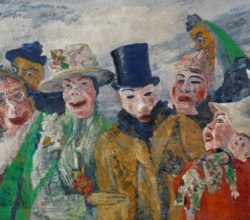
Grotesque figures painted in cheery hues – just one of many curiosities that are James Ensor. He lived in coastal Belguim, looking after his parents’ curio shop. His art, as one critic put it, expressed the world “from above the shop”. Early career bourgeois interiors gave way to masks, skulls and fantastical images. Beyond categorisation seems a consensus view. Unsettling, too.

The First of the New

Rauschenberg felt the abstract expressionists were too much into their own dramas. He wanted to show the beauty of everyday objects, a focus that anticipated soon-to-arrive Pop art. Warhol has since overshadowed Rauschenberg, but that might change with a forthcoming major retrospective. It will aim to show that “all the values, aesthetics and processes of contemporary art are there in Rauschenberg’s earliest work”.

Yves Klein, the young Frenchman who pre-dated the pop art youthquake

How appropriate that, soon after the discovery of a new blue, there should be a retrospective of Yves Klein’s work. Klein’s multi-faceted work helped pave the way for minimalism and performance. Along the way, he developed a vivid pigment, International Klein Blue. Colour, he felt, was the best way to express infinite space and immateriality. Apparently his artistic motto was “For color! Against line and drawing!”

The Fateful Attraction of Jasper Johns and Edvard Munch

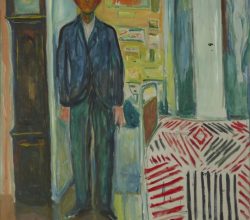
Curatorial brows furrowed when it was realized that Jasper Johns had referenced Edvard Munch in his own work. Any such linkage seemed unlikely given their disparate styles. A resultant exhibition tries to show that, when the AIDS crisis was at its height, Munch may have helped inspire a “sea change” in Johns’ work. But all this analysis and conjecture only goes so far: the link, admits the writer, remains “fraught with ambiguity.”

LIFE: ★★★½

As a MoMA security guard, Gene Beery noticed gallery goer’s interest in text. That set him on a path to be a painter of text. Beery’s quirky linguistic paintings have attracted only a small following – surprising given how web friendly they are. Perhaps a breakthrough moment might come, perhaps not. Perhaps art buyers are heeding his advice in one painting: “USE THIS / AS A PAINTING / IN AN / AESTHETIC / EMERGENCY ONLY“.