The Easel

15th November 2016

EASEL ESSAY: Andrew Wyeth, his Critics, and Small Town Mud

Andrew Wyeth might just be America’s most popular painter. People feel at ease with his work. It seems straightforward, depicting rural and small town scenes that figure large in America’s yearnings about itself. But contemporary critics were not enthused and little has changed since.

Well, the critics should look more closely, argues Contributing Editor Morgan Meis. Wyeth’s favourite subject was indeed small town America. But he wasn’t trying for nostalgia or homey. Rather, he was seeking to tap into the particular psychology of that world, the mood of a small town that is so different to city life.

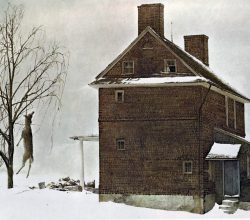
“There is one other crucial element to Wyeth’s [Tenant Farmer]: the dead deer hanging from the rope of a solitary tree. The deer hangs ominously, by the neck, like it has been executed for a crime. … On the one hand, there is the house—that massive pile of reddish bricks crying out for all the materiality that tempera can deliver. The bricks want to be given their due, each brick … But the bricks of Tenant Farmer are merely an inert mass without the hanging deer. The deer brings that disturbing incongruence into the picture, that element of risk. It’s as if the hung deer and the brick house need one another. Together, they become complementary components of the undeniable reality that Wyeth wants to show us.”

Go to LACMA for John McLaughlin, possibly the most important postwar artist you don’t know

Artists from places other than New York can find recognition a bit harder to come by. In the case of California based John McLaughlin, he was also self-taught and a loner. His first retrospective at a major institution, 40 years after his death, supports claims that his work was path breaking, anticipating minimalism by a decade. And the subject that most inspired this contemplative work? “[T]he viewer’s act of seeing”.

Review: James Ensor By Luc Tuymans, Royal Academy ‘Unsettling’

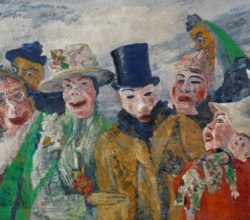
Grotesque figures painted in cheery hues – just one of many curiosities that are James Ensor. He lived in coastal Belguim, looking after his parents’ curio shop. His art, as one critic put it, expressed the world “from above the shop”. Early career bourgeois interiors gave way to masks, skulls and fantastical images. Beyond categorisation seems a consensus view. Unsettling, too.

The First of the New

Rauschenberg felt the abstract expressionists were too much into their own dramas. He wanted to show the beauty of everyday objects, a focus that anticipated soon-to-arrive Pop art. Warhol has since overshadowed Rauschenberg, but that might change with a forthcoming major retrospective. It will aim to show that “all the values, aesthetics and processes of contemporary art are there in Rauschenberg’s earliest work”.

Yves Klein, the young Frenchman who pre-dated the pop art youthquake

How appropriate that, soon after the discovery of a new blue, there should be a retrospective of Yves Klein’s work. Klein’s multi-faceted work helped pave the way for minimalism and performance. Along the way, he developed a vivid pigment, International Klein Blue. Colour, he felt, was the best way to express infinite space and immateriality. Apparently his artistic motto was “For color! Against line and drawing!”

The Fateful Attraction of Jasper Johns and Edvard Munch

Curatorial brows furrowed when it was realized that Jasper Johns had referenced Edvard Munch in his own work. Any such linkage seemed unlikely given their disparate styles. A resultant exhibition tries to show that, when the AIDS crisis was at its height, Munch may have helped inspire a “sea change” in Johns’ work. But all this analysis and conjecture only goes so far: the link, admits the writer, remains “fraught with ambiguity.”

LIFE: ★★★½

As a MoMA security guard, Gene Beery noticed gallery goer’s interest in text. That set him on a path to be a painter of text. Beery’s quirky linguistic paintings have attracted only a small following – surprising given how web friendly they are. Perhaps a breakthrough moment might come, perhaps not. Perhaps art buyers are heeding his advice in one painting: “USE THIS / AS A PAINTING / IN AN / AESTHETIC / EMERGENCY ONLY“.

8th November 2016

Kerry James Marshall’s America

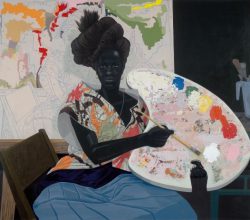
“A stone cold stunner” is one critic’s response to this retrospective. Marshall’s work celebrates everyday African American life with a figurative style that sits entirely within the traditions of Western art. His work helps correct the glaring absence of African Americans from the American art canon. For this critic the show has “a breakthrough feel: the suggestion of a new normal, in art and in the national consciousness.”

Rodin and Dance: The Essence of Movement, Courtauld Gallery

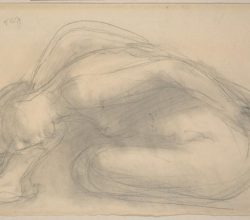
By the early 1900’s Rodin was financially secure and able to pursue a particular side interest – dance. He was attracted by the challenge of capturing the fluidity of movement in clay. His predecessor Degas had built his reputation with studies of the world of classical ballet dancers. Rodin, in contrast, was interested in modern dance, Nijinsky’s radical innovations, the visual imagery of a new century.

Carroll Dunham: Eyes Wide Shut

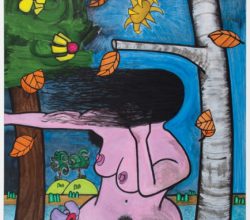
Well regarded artist Carroll Dunham was asked about his recent work “What is it with all the female genitalia?” His Bathers series contains not classical nudity but “raw, Larry Flynt-style sexual display”. The artist is not intending to arouse, nor are his feminist credentials in doubt. What follows is a thoughtful and elegant consideration of an awkward topic – “a quixotic erotic innocence”. More images (NSFW) are here.

Holding Onto Form And Passion: Agnes Martin’s Guggenheim Retrospective Reveals How Her Self-Incarceration Produced A Visual Utopia

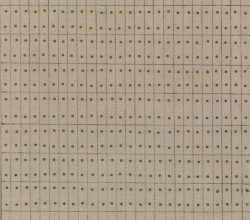
Martin was tempted back to New York in 1957 by the offer of an exhibition. She left after a decade, having worked alongside other great American artists. Was she most influenced by abstract expressionism or minimalism? For Martin, this question was of little interest:  “I paint about perfection that transcends what you see — the perfection that only exists in awareness”. An interview with her biographer is here.

A Beginner’s Guide to the Artists Shortlisted for this Year’s Turner Prize

The Turner Prize is Britain’s most prominent art prize. It focuses on art from artists under 50 and is not shy about controversy. In such a spirit, one reviewer identified the likely winner seemingly by deduction, the alternatives being dismissed as “idiotic”, “a bit trivial” and “nothing much to write home about”. The linked piece is admirably restrained – interesting background on the four shortlisted artists.

Many strategies for survival: Barbara Rose on painting after Postmodernism

The demise of painting has often been proclaimed. Duchamp declared it dead in 1918. In the 1960’s it was deemed “an irrelevant relic of bourgeois culture”. Lately the challenge comes from mass culture imagery and new media. But the writer is optimistic about painting. Serious artists are making carefully worked canvasses, aiming to create “the wholeness of the aesthetic experience made available by the Old Masters.”

Singapore Biennale 2016

In the market for Asian art, big art fairs often generate the headlines. But, if your interest is understanding regional art activity, survey shows like the Singapore Biennale might be more informative. Asian art covers diverse visual, philosophical and religious traditions so generalisations are difficult. But this critic offers one – “sophistication and self-confidence [is evident in] the art of even the poorest countries.”