The Easel

14th February 2017

From Black Flag to Charles Manson, Raymond Pettibon’s New Museum Retrospective Has Something for Everyone

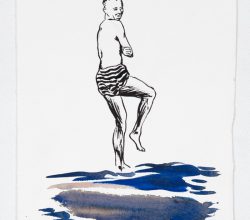
Right from his youth Pettibon has drawn. His images seem straightforward but become ambiguous with the addition of snippets of text. Those snippets are “as researched and studied as the drawings themselves”. Often they convey social criticism – is there a unifying theme? Is it “the dissolution of American idealism”? asks one critic. The writer identifies another source of ambiguity – “Who is speaking in this work?
Pierre Gouthière: Virtuoso Gilder At The French Court

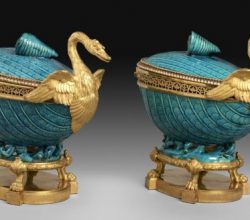
Decorative art gets a moment’s prominence with an exhibition of the work of eighteenth century French gilder Pierre Gouthière. He enjoyed contemporary acclaim for his extraordinary gilt-bronze creations but then along came bankruptcy and the Revolution. “Ultimately [Gouthière’s works] are not stereotypes, they are not archaeological at all, but … a close look at nature.” More images are here and a video (11 min) on his techniques here.

Ken Price: “A Survey of Sculptures and Drawings, 1959 – 2006”

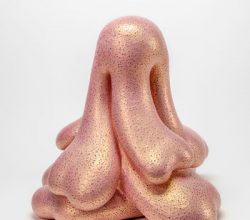
It is perhaps an indicator of the changing status of ceramics that American ceramicist Ken Price is now sometimes referred to as a sculptor. Influenced by Los Angeles’ commercial art, he subsequently explored artisanal Mexican pottery. He is best known for his abstract shapes and a characteristic work method of painting unglazed fired clay. Background on the artist is here.

Atmospheric insights into a world of privileged bohemianism – Vanessa Bell, Dulwich Picture Gallery, review

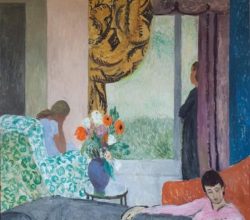
Vanessa Bell was a core member of the famous Bloomsbury group of intellectuals. Mid-career she was at the forefront of the English response to European modernism. However, her profile as an artist remains low – she is more famous for the company she kept. Conceding that some of her works are strong this writer nonetheless is unimpressed: “her work is essentially derivative”.

A Painter of the Shattered World

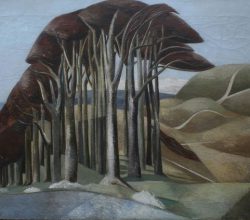
Paul Nash seems to present to English art critics as a mystery to be solved.  First and foremost he was a painter of the English landscape. But the blasts of modernism from Europe clearly impacted his work. Were his strange landscapes different enough to be called avant-garde? Perhaps not. At career’s end we see “less Nash the pioneer [and more] Nash the painter of an odd, spiritualized, peculiarly English countryside”.

Ignore the art market – there is only one Bruegel that matters

The UK discovery of a work by Brueghel the Younger has been widely reported. But how much fuss should be given to a work that the artist painted 31 times and copied from his genius father (Bruegel the Elder)? Does the market understand the difference between father and son?  “Brueghel the Younger is not a great artist: There are so many [of his] works … lying around in stately homes [for] a keen market [to] draw on”.

Image: Holburne Museum

Who was the real Victor Pasmore?

How do you characterize a painter who cycles through nearly every style? Pasmore started off as a “sort of Impressionist” but then journeyed through cubism, Old Masters realism, romantic landscapes … and abstraction. Pasmore himself didn’t identify with any particular style – “I call it … art that is independent like music.” But critics love to categorise: “he was at his peak … between figurative art and abstraction.”

7th February 2017

The Art Machine: The Centre Pompidou at 40

The Pompidou has been hugely successful.  Its radical design, coming from then unknown architects, yielded a highly workable building. Further, its “genius” first director created a defining inter-disciplinary programme. Perhaps most importantly, its aspiration to be accessible to the general public has worked. Perhaps too much: “[we want] openness and accessibility … but we also have to defend more and more the silence.”

At the Fondation Louis Vuitton

The Shchukin collection currently showing in Paris has multiple back stories: “frenemy” collectors, friendships with famous artists, inspired choices (51 Picassos) but puzzling omissions (1 Braque). Its dazzling quality prompts an imponderable question: “What must it have been like … to have been that collector, with that money, in that Paris, at that time – that short, brilliant period of European art?”

Jimmie Durham’s art throws some well-aimed stones

After art school Jimmie Durham gravitated toward theatre but got side tracked into the movement for Native American rights. Ambivalent toward his homeland he moved to Europe where he is now widely recognised. At his first major US show in decades, issues of identity are still an animating force in his art. And what is that identity? I am, he declares, “a full-blooded contemporary artist, member of the tribe of sculptors.”

The Joy of Eighties Art

Minimalism ruled the New York art scene for a decade but by about 1980 it was time for change. A variety of sensuous, cheeky figurative artists came to the fore, along with the first influx of big money.  A further decade along, AIDS had sapped the energy of this moment. The 80’s style of engaging the viewer with “stroke by stroke intimacy and nuanced elegance” yielded to Jeff Koons cool sculptural installations.

Image: Whitney

Bauhaus Masters Josef and Anni Albers Obsessively Collected South American Art

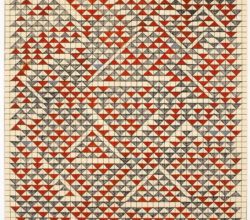
Is Bauhaus design and pre-Columbian art such a strange coupling? Both Albers taught at the Bauhaus. After emigrating to the US, Latin American art strongly influenced their work– he in colour theory, she in textiles. “For the Albers, art and the visual had to be everywhere in your life, and in Mexico, art was everywhere. They felt that people there were living with visual flair … which was the dream of the Bauhaus.”

The Late Flowering of Rose Hilton

Rose was married to Roger, a famous artist but also a domineering alcoholic. Any painting she did had to be done in secret. She reflects “I was possibly of that generation where women gave in to their man.” Since his death there has been a “dam burst of creativity”. Her earlier abstractionist style now often gives way to figuration. Gallery representation arrived late but since then multiple shows, a retrospective and now a biography.

As Top Tier Artists Age, the Art World Hopes to Cash In

With the escalation in art prices the estates of some artists are worth millions – or even billions.  Who will manage their estates? The big auction houses, galleries and art consultancies all have ambitions and are busy tweaking their business models to exploit this new line of business. As a Sotheby’s executive comments “We are not an auction house; we are an art business”.