The Easel

8th November 2016

Kerry James Marshall’s America

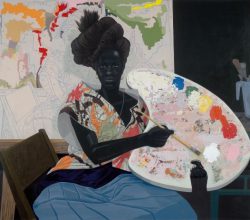
“A stone cold stunner” is one critic’s response to this retrospective. Marshall’s work celebrates everyday African American life with a figurative style that sits entirely within the traditions of Western art. His work helps correct the glaring absence of African Americans from the American art canon. For this critic the show has “a breakthrough feel: the suggestion of a new normal, in art and in the national consciousness.”
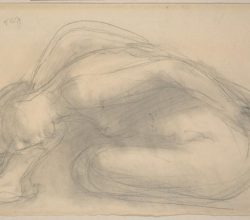
Rodin and Dance: The Essence of Movement, Courtauld Gallery

By the early 1900’s Rodin was financially secure and able to pursue a particular side interest – dance. He was attracted by the challenge of capturing the fluidity of movement in clay. His predecessor Degas had built his reputation with studies of the world of classical ballet dancers. Rodin, in contrast, was interested in modern dance, Nijinsky’s radical innovations, the visual imagery of a new century.

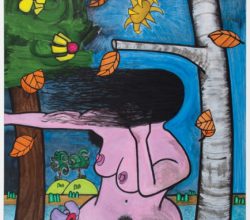
Carroll Dunham: Eyes Wide Shut

Well regarded artist Carroll Dunham was asked about his recent work “What is it with all the female genitalia?” His Bathers series contains not classical nudity but “raw, Larry Flynt-style sexual display”. The artist is not intending to arouse, nor are his feminist credentials in doubt. What follows is a thoughtful and elegant consideration of an awkward topic – “a quixotic erotic innocence”. More images (NSFW) are here.

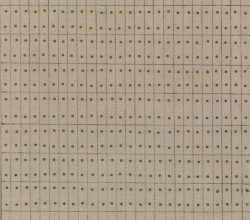
Holding Onto Form And Passion: Agnes Martin’s Guggenheim Retrospective Reveals How Her Self-Incarceration Produced A Visual Utopia

Martin was tempted back to New York in 1957 by the offer of an exhibition. She left after a decade, having worked alongside other great American artists. Was she most influenced by abstract expressionism or minimalism? For Martin, this question was of little interest:  “I paint about perfection that transcends what you see — the perfection that only exists in awareness”. An interview with her biographer is here.

A Beginner’s Guide to the Artists Shortlisted for this Year’s Turner Prize

The Turner Prize is Britain’s most prominent art prize. It focuses on art from artists under 50 and is not shy about controversy. In such a spirit, one reviewer identified the likely winner seemingly by deduction, the alternatives being dismissed as “idiotic”, “a bit trivial” and “nothing much to write home about”. The linked piece is admirably restrained – interesting background on the four shortlisted artists.

Many strategies for survival: Barbara Rose on painting after Postmodernism

The demise of painting has often been proclaimed. Duchamp declared it dead in 1918. In the 1960’s it was deemed “an irrelevant relic of bourgeois culture”. Lately the challenge comes from mass culture imagery and new media. But the writer is optimistic about painting. Serious artists are making carefully worked canvasses, aiming to create “the wholeness of the aesthetic experience made available by the Old Masters.”

Singapore Biennale 2016

In the market for Asian art, big art fairs often generate the headlines. But, if your interest is understanding regional art activity, survey shows like the Singapore Biennale might be more informative. Asian art covers diverse visual, philosophical and religious traditions so generalisations are difficult. But this critic offers one – “sophistication and self-confidence [is evident in] the art of even the poorest countries.”

1st November 2016

Beyond Caravaggio review: a masterpiece of surprise

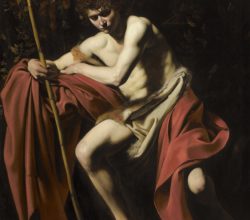
Caravaggio was immensely influential while alive but then promptly forgotten until the mid-1950’s. His innovations were substantial – closely observed real life detail, the interplay of light and dark, his dramatic tableaux, and more. But he had another quality important to the modern eye – “The realism of Caravaggio … is … neither logical nor scientific. It is an appetite for life.” An excellent video (3.5min) is here.

The Trick to It All: A Conversation with Photographer Henry Leutwyler

Photography, according to Leutwyler is “an art of free spirit”.  Famous for his portraiture, he also photographs objects with famous owners. “Every object talks. I photographed the first edition of Peter Pan that was owned by Michael [Jackson] … the musical genius of this kid that didn’t have a proper childhood recreated a childhood at Neverland. Disaster. Heavy, heavy, heavy load of history, every single object.”

‘Max Beckmann in New York’, a Belated but Full-Blown Homage to a German Modernist

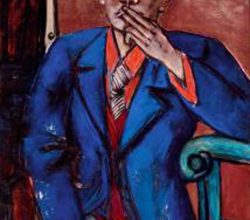
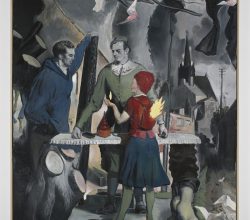
Traumatized by his military service in WW1, Beckmann used his art to show Europe’s military madness. His intense imagery brought renown as one of Weimar Germany’s greatest artists until Hitler’s regime deemed him a ‘degenerate’. Emigrating to the US after WW2 he found New York much to his taste, enjoyed a burst of creativity but died within a year of arrival. A useful background piece is here and more images here.

2016 Power 100

London based ArtReview has just released its Power 100 list of the art world’s powerful people. The rankings are based around who influences the art that gets seen, as judged by an international panel. Gallerists get the most mentions followed by artists, collectors and curators. No art advisers or art critics made the cut. ArtReview’s defence of the list is here and a critic’s review of the rankings is here. Make of it what you will!

Nick Moore writes on Robert Motherwell, “Abstract Expressionism” at the Bernard Jacobson Gallery

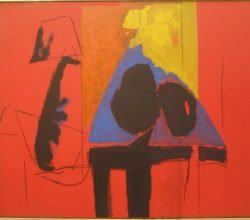
Among Abstract Expressionists, Motherwell was the odd man out. He had family money and a first rate education. His outlook was intellectual, “too French”. He felt no particular need to develop a signature style. Perhaps as a result, he is not always given his due as a great abstract painter. However, at a show in London his “versatility and breadth”, in painting and collage, is on full display.

Neo Rauch and the carnival of European art

Describing Rauch’s work invites a fruit salad of jargon. Surrealism and East German social realism are key influences and give his work an “unanchored strangeness”.  The reviewer of his first UK show approves, concluding that his work comes together into “a strangely convincing whole”. Rauch resists such analysis, commenting simply that his art is “a precisely-aimed reach into the immeasurable flow of things”.

Alan Gouk writes on Abstract Expressionism at the RA

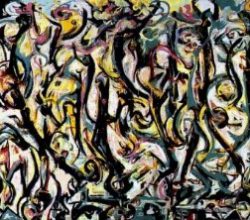
More AbEx! The Royal Academy’s Abstract Expressionism show may be pulling in the crowds but there is still space for dissenting voices. Clyfford Still – “artistically somewhat inert, inexpressive”. Barnett Newman – “colossally over-rated”. Franz Kline – “simply a very bad painter”. Joan Mitchell – “a vapid work”. One can only wonder that if these artists are not worthy of attention, who is?