The Easel

2nd December 2025

Recollecting Forwards

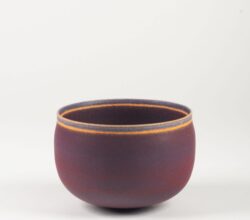
Siesbye happily agrees she makes nothing but ceramic bowls. Her unadorned pieces reflect ancient Anatolian forms with a modern Scandinavian overlay. Why does such seemingly plain work get so much acclaim? Partly it’s their refined designs with tiny bases and flowing lines. More though, it’s their beguiling simplicity. As Morandi (a Siesbye favourite) demonstrated “there is nothing more complicated than simplicity.” Siesbye notes the ultimate form of her work is “decided by the clay”. Images are here.
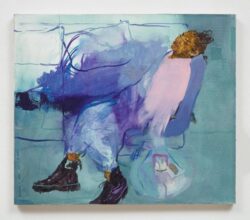
Jennifer Packer: Dead Letter

Packer is a rising star in American art, enjoying solo shows and major awards early in her career. Her latest exhibition showcases her portraiture. It’s “a memento mori” says one writer,  “what traces [people] leave after they are gone”.  That seems apt, Packer having recently suffered a personal loss. In one work “two perfectly rendered feet touch the ground. Meanwhile, the figure drifts upward and away. Packer’s layering —of paint, gesture, and meaning— mirrors the complexity of mourning.”

The Conjurer of the Sublime vs. The Cloud Architect: Turner and Constable at Tate Britain shows off a good old fashioned rivalry which is utterly spell-binding

Turner v Constable is one of art’s great rivalries. During their lifetimes that rivalry had a personal edge – the mercurial, Turner versus the “doggedly local” Constable. Turner’s scenes of turbulent weather sometimes verge on abstraction while Constable was able to show the “transcendent ordinariness” of the British landscape. So, who comes out ahead? This writer chooses Turner as the “out and out winner of this painterly race”. Strong cases for Constable are mounted here and here. The debate continues.

Robert Therrien’s smashing retrospective is among the year’s best museum solo shows

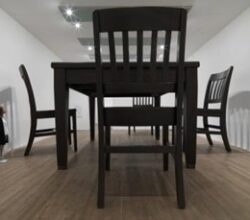
In the Broad Museum in LA, a 26 foot long table with matching 10 foot chairs is a hugely popular work. The key to this most acclaimed of Therrien’s works is not its size but what it evokes. Made exactly to scale, it reminds the viewer of “narratives and memories from childhood”. Similarly, a gigantic pile of plates forms a teetering sculpture that triggers our anxieties about plates breaking. Says a curator Therrien’s uncanny skill was to tap into the tension between “what an object is and what it means”.

William Nicholson and the pleasure in the paint

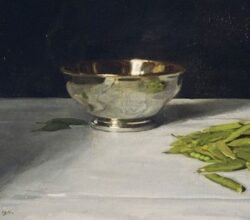
The perils of versatility. Nicholson started by designing posters where he showed “an aversion to the extraneous”. Then came book illustrations, portraits, “iconic” still lifes and landscapes. Out of all that his posters have proved influential as have his “striking” portraits. Versatility is enough to make him “beloved” but too much to be deemed distinctive. Nicholson seemingly was unconcerned, wanting only to “communicate what in the natural is irresistible and … what in the act of communication is pleasurable.”

25th November 2025

When Homer Went to Gloucester

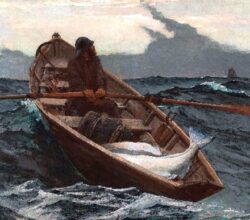
Homer was slow to pick up watercolour. By mid-career, though, he became the pre-eminent American artist of this luminous but tricky medium. This was a time when the great outdoors lost its religious connotations. That suited Homer’s observational style and led to what became his late, great subject – the sea. He painted the drama of the ocean and portrayed the fishermen who worked it as “industrious”. It was with such images that Homer created a place for watercolour, and himself, in American art.

Spectrum of desire

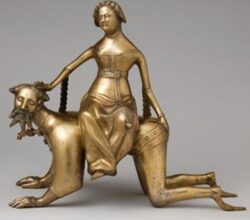
If you think of medieval art as purely religious, you are missing some of the story. Sex and desire was a “multifaceted” concept that frequently appeared in devotional images. Experiences did not divide neatly between spiritual and secular. Gender was a fluid concept. Medieval thinkers thought “Christ was a mother to humanity”. Lust, a no-no if purely carnal, was acceptable if part of devotional practice. Just as in our time, “there is no defence against desire, and desire continually disrupts”.

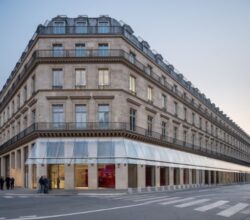
Get Cartier! How Jean Nouvel turned an old Paris department store into a museum to rival the Louvre

Fondation Cartier was established by the luxury brand to collect and exhibit contemporary art. Its experimental, “anything goes” approach is exemplified by its new building, a renovated department store near the Louvre. Notably it has “insanely expensive” moveable floors that create varied exhibition spaces. Says a curator “exhibition-making is at the centre of culture, a succession of ideas … subject to constant change.” Says one writer its “a massive machine for the unexpected.”

Unintended Beauty

The German photographer Andreas Gursky pioneered images of industrial buildings and infrastructure. Wiper has emerged as another photographer exploring that industrial aesthetic. His work didn’t emerge from a prior interest in industry or engineering but rather from discovering their “accidental aesthetics. You have this first layer of graphical symmetry … [but] there’s another layer of ‘what’s actually happening here [We are dissociated] from the science and technology underpinning our lives”.

The rise and rise of private foundations in France

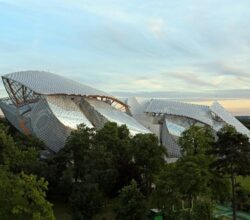
Paris has a history of philanthropy toward art. It is also unusual for its six or so large wealthy private art institutions. Encouraged by tax breaks for cultural activities plus (of course) the potential for brand building, they easily outcompete the public museums for acquisitions and exhibitions. The Louvre, with its crumbling building and parlous security offers a stark contrast. Responds one private foundation, the “richer cultural offering” now available in Paris “is good for artists and visitors alike”.

Finland’s lighthouse

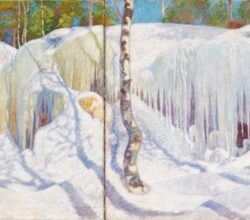
Like many aspiring artists, Halonen went to Paris to absorb its modernist vibe. He picked up the fashions of the 1890’s – Primitivism (studying under Gauguin), post-Impressionism, the Japonisme craze – and took it all back to Oslo. What emerged from his studio, though, was the Finnish landscape in all its variety. His winter scenes drew particular acclaim, showing blue-ish shadow falling on the snow. In a country still under Russian rule, that work helped coalesce a Finnish sense of identity.