The Easel

1st July 2025

Anselm Kiefer takes on Van Gogh, with results both heroic and absurd

It sounds a good idea – putting van Gogh alongside Kiefer, the German artist who is such an admirer. Parts of the show work –dour late van Gogh’s rhyme with Kiefer’s bleak landscapes. However, the Kiefer works, huge and sometimes bombastic, are shown up by the subtlety of the smaller van Goghs. And van Gogh did have sunny moments. Kiefer, in contrast, is solid “Teutonic angst”. But let’s make allowances. Van Gogh died in peaceful 1890; while Kiefer has painted with two wars weighing on him.

Yoshitomo Nara review: cutesy terrors swear, smoke, play guitar and burn down houses

When this show was in Bilbao, it attracted the praise one might expect for a highly successful artist. Yet, there was a hesitation – perhaps Nara’s art is straightforward fun and lacks the “profound emotional depth” that some claim. Now it has opened in London, this writer has a view on thar. For years Nara has produced “cutesy kitsch with a vicious edge. I quite like it. [Yet} I’ve never encountered a show less in need of explanatory wall texts, or more resistant to artsy over-intellectualising.” Images are here.

Alice Adams, Louise Bourgeois, and Eva Hesse delve into art’s ‘uckiness’ at The Courtauld

A 1966 sculpture exhibition in New York featured work that was breaking away from minimalism for something more sensuous. It earned the title ‘eccentric abstraction’. That sensibility has endured and appears in a London show via works that focus on body parts and textures. Erotic it is not, with “bulging, drooping sculptures” and “various turdlike piles and unpleasant growths and cavities”. It’s more a confrontation with “bodiness” – the works are “very tempting to touch”. A video (4 min) is here.

Peter Zumthor’s controversial LACMA wing is flawed and thrilling

Los Angeles’ new LACMA building has opened for preview. It’s a better building that what it replaces (phew!) though with a slightly smaller area to display art. It is designed so that visitors can “curate their own journey” and allow a more diverse, less “Eurocentric” display of art. But did these objectives require a “curvilinear behemoth” that one long-time critic calls  “absurd”? A final verdict will await the art to be installed but, for $800m, LACMA must have been hoping for a more rapturous reception.

Vatican exhibits Raphael’s legacy with the reopening of the Hall of Constantine

In 1508, Raphael began painting four rooms in the Vatican. He died in 1520 before finishing the fourth, “most important” room, leaving that to his workshop. A decade-long cleaning shows the frescoes to be the “peak of high Renaissance artistry”. Michelangelo was working on the Sistine Chapel at the same time. While away in Florence (says a background piece), Raphael took a sneak peek and was impressed. “Some of his figures [become] bigger, brighter, more monumental: he has now seen Michelangelo.”

Technology in the service of art

Inspired by the surrealists to “change the rules of the game”, Lijn has spent her career making sculpture that mixes art and science. That means kinetic sculpture, poetry-infused machines, and various animated installations. Regrettably, her unconventional work, now given a prestigious retrospective, is being smothered by impenetrable jargon. For example, is her work “technological feminism – and what exactly does that mean? It’s all a bit unclear. An interview with the artist is here.

24th June 2025

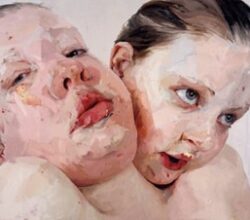
How Jenny Saville turns paint into flesh

Saville’s acclaimed works look like portraits except that she says they are actually paintings about the act of painting. She acknowledges the influence of compatriots Bacon and Freud but also abstractionists like de Kooning and Twombly. From them she draws “energy” but what she paints are fleshy, visceral, imperfect bodies that impart, says one writer, the “ungraspable but omnipresent realness of others”.  Amidst a string of 5-star reviews for Saville’s retrospective this writer says “she has the verve of a great artist”.

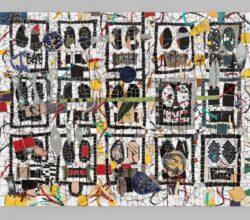
Rashid Johnson

Starting out, Johnson was called “post-Black” for his avoidance of racial stereotypes. Now honoured with a mid-career survey, do we see him more clearly? Besides his original medium of photography, he works across video, painting, mosaic and sculpture. One critic groans about “hectic conceptualism” – lots of ideas, some great but others that are “too esoteric”. The linked piece notes all the allusions and wonders if Johnson’s work is “activism [or just] décor … I’m not so sure”.

Curator Robert Fucci Unpacks the Narrative Intrigue of ‘Vermeer’s Love Letters’

To celebrate its renovation New York’s Frick is showing three Vermeers, each a genre scene that focus on a favourite theme, the love letter. Dutch society in Vermeer’s day was not always willing to let women choose their partners. The love letter, often transmitted by one’s maid, was one way to steer events in a desired direction. So, in these paintings, there is dramatic tension – will love win out? Says one critic “three staggeringly beautiful works”. A backgrounder is here.

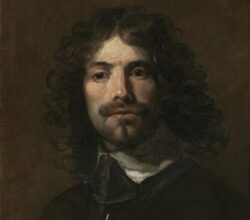
Historic portrait by ‘Britain’s Caravaggio’ bought for the nation

London’s National Portrait Gallery says William Dobson was “the first great British painter”.  Few remember him today but that may change with the official purchase of his self-portrait. Painted around 1637, the work stands out amidst that era’s “stiff” portraits. It is fluent, with thickly applied paint and “oozing romantic self-absorption”, giving it  an“un-English” psychological mood. “Suddenly, out of nowhere, we have a native Caravaggio”. The gushing official announcement is here.

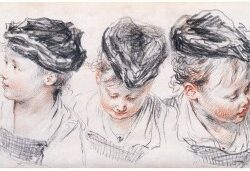
Antoine Watteau’s studies in elegance

When we think Watteau, we think of paintings of aristocratic frivolity. He was slow, it seems, to pick up his painting brushes but, when it came to drawing, he was “almost obsessive”. He drew constantly, with some images eventually appearing in his paintings. Yet Watteau’s repeated alteration of his drawings is evidence that he saw them as artworks in their own right. His skill in focusing on a figure “gives many of his drawings an almost cinematic quality, which he never fully reproduced in paint.”

Paul Poiret: How Fashion’s Maverick Turned Couture Into Art in Paris

Poiret opened his fashion house in 1903. Soon he was famous for his “streamlined and unstructured” fashions that liberated women from the corset. These clothes, often colourful and “draped rather than tailored”, celebrated natural form and were a “sartorial revolution”. Extravagant ambitions eventually forced the sale of his fashion house in 1929. Insisting on the “unity” of art and fashion, Poiret also influenced home décor and pioneered the use of spectacular events for brand marketing.