The Easel

15th July 2025

Emily Kam Kngwarray, Tate Modern review – glimpses of another world

London’s Tate is broadening its view of the art canon and holding a solo show of the Indigenous artist Emily Kngwarreye. It seems likely to further boost her already escalating reputation, with one critic calling it a “total knockout”.  The linked piece gets clunky where it tries to view her works too literally. One comment, though, is spot on: “a mesmerising overlay of dots in pinks, yellows, ochres, oranges, greens and lilac … the paintings are in a sense landscapes, they are not about looking at a view but being immersed in a place.” [Ed. I am currently writing a book about the art career of Kngwarreye}

Paolo Veronese, at the Prado Museum: “For his elegance, he is the Cary Grant of Venetian painting”

Veronese’s move to Venice in 1551 was gutsy. He would be going up against two great artists, Titian and Tintoretto, although he was only in his mid-20’s. Major accomplishments followed, notably psychologically insightful portraits and group scenes, painted in beautiful colours with “loose, quick” brushwork. Yet he is now rather overlooked. Unlike artists such as Caravaggio, Veronese was not an art world bad boy, causing trouble. He was. though, “one of the most important artists in Western painting.”

What If the Art World Isn’t Collapsing But Changing Hands as It Should?

All parties come to an end. It seems the art market is no longer booming, something especially noticeable at the high end. Enthusiasm in China for private art museums (it has over 2000) has cooled. Some have closed while others are in a ‘not dead-not alive’ state. In the US there has been a spate of retirements of prominent players. One gallery founder moans “I have never heard or seen more people speaking so bluntly about the crisis they’re feeling”.

Kengo Kuma’s ‘Paper Clouds’ in London is a ‘poem’ celebrating washi paper in construction

One of the notable exhibits at this year’s London Design Biennale was a Japanese work comprising hanging panels of washi paper. At one level the ethereal work suggested “sunlight breaking through clouds”, where the washi clouds “hovered between visibility and dissolution”. Besides being a sculpture, though, it was also an ode to washi, the paper with personality. Made with fibre from shrubs rather than trees, it is strong, light, textured, reusable and, most of all, poetic.

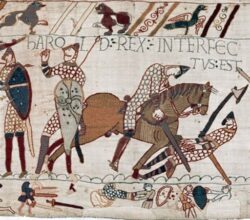
There’s more to the Bayeux Tapestry loan deal than meets the eye…

At 900+ years old, the Bayeaux Tapestry is as much cultural artifact as artwork.  Made with wool and linen by English nuns (probably), it commemorates the French victory in the 1066 Battle of Hastings. Its 58 scenes describe military gear, seafaring, and everyday life. The British Museum predicts that when it arrives in 2026, it will be “THE blockbuster show of our generation.”. Speculates the writer, perhaps the Tapestry loan foreshadows how the British Museum might eventually return the Elgin Marbles to Greece.

8th July 2025

Turning Style into Power

In the late 1700’s, men’s fashion shifted to a more restrained look. London’s much admired Beau Brummell exemplified a new idea – the dandy, someone who cut a striking figure.  Black men saw being a dandy as a way to assert their individuality and sensuality. Further, elegant attire was “a quiet but confident assertion of self-respect”. Musicians like Miles Davis created a “hip, tailored style” that was widely adopted. A distinctive Black sartorial aesthetic had successfully “subverted … the racial hierarchy”.

Wangechi Mutu’s Debut Rome Exhibition At Galleria Borghese

Mutu’s star seems ever ascendant, becoming the first living female artist to have a solo show at Rome’s Galleria Borghese. Amidst the villa’s opulence and spectacular art, Mutu’s work is a “counterpoint”. Some of her materials are humble – wax, wood and soil – things usually absent from art history’s grand narratives. Bronze, such a heroic material, is “reimagined as porous and ancestral”. In various ways, she asks, “who is seen … who is erased?” Mutu’s work, says the writer, is “elegant yet subversive”.

The elephant in the room: India’s cultural influence takes centre stage

India’s story is illuminated through the devotional art of its great religions – Jainism, Buddhism and Hinduism. This art has amazing longevity – beginning about 2500 years ago – and boasts a sphere of influence right across Asia. Its sophisticated “cultural and linguistic apparatus” transformed cultures and yielded painting, sculpture, Zen meditation, haiku, Japanese ink wash landscapes as well as Ankor Wat and Borobudur. ” One of the most thought-provoking and aesthetically satisfying shows for years.”

What Does It Feel Like to Be Called an Emerging Artist at 72? Ask Takako Yamaguchi

Suddenly, 70-ish Yamaguchi is hot, both in the auction room and with a first solo show in LA. She isn’t sure why recognition has arrived now, after decades of work. Perhaps it has been delayed by her “nonchalant” changes in style, borrowing from “the trash-heap of discarded ideals”. Her current interest is semi-abstract seascapes inspired by artists like Georgia O’Keefe. Before that, it was an acclaimed series of photo-realist shirts. “My work is not in the present … it’s either the past or the future”. An interview with the artist is here.

Artist Ben Shahn’s Nonconformity

Contemporaries of Shahn called him “overpowering”, a comment that owed much to his passionate support for leftist causes. For him, art was a means to focus attention on social and political issues. Working from photographs, he painted modern-ish figurative works that captured the troubles of the Depression and the hopes of the New Deal. That was Shahn’s career highpoint, after which it declined as the post-war world fell for abstraction. Says one critic, a “revelatory survey”.

What happens when priceless art is damaged – and the people who fix it

Velasquez’s Rokeby Venus has been attacked twice in the last century. Given its enormous value, the cost of painstaking restoration was irrelevant. More frequently, artworks are damaged accidently – usually by workers in a gallery. Advances in materials science allows near-miracles to be worked, assuming someone is willing to pay. Involving the artist can be tricky because they may use the opportunity to re-work the piece. Some galleries recognise their art as “living and so introducing the possibility of death.”