The Easel

8th April 2025

Ed Atkins’ Digital Surrealism Unfolds in Tate Britain’s Largest Survey to Date

As mundane digital functions infiltrate daily life, we all acquire a digital representation of ourselves. Atkins survey show in London focuses on these versions of  ourselves, on the “me and “not-me”. His work deals with “the in-betweens: between physical and digital”, in ways that are deeply human. Emotion matters, death matters, people are awkward. “Atkins dares to ask what it means to be human when your body is rendered in code and your feelings come with a loading screen”.

Mahtab Hussain: What Did You Want to See?

British Asians in Birmingham – predominantly Muslim – have long suffered racist stereotyping. Having been criticised for being either too Asian or too British, Hussain has had to think hard about identity. A solo show features portraits of individual British Asians together with images of Birmingham’s 160 mosques. Far from confirming the usual stereotypes, it’s a study in “mind-boggling diversity”, which is Hussain’s point. Perhaps like himself, “Birmingham [has] a very messy identity. It doesn’t know who it is.”

Bruce Nauman’s pensive Conceptual art from the 1970s seems timely again

Nauman moved to Los Angeles in 1969 seeking inspiration. He took contemporary art seriously, especially Duchamp and his pun-laden works. One Nauman work from 1968 was a weighty steel slab titled “Dark”. Did that mean it was dark under the slab? Was the title written under the slab, as the artist claimed? The writer describes this work as “a compact of faith … a contract between strangers,”. That was a significant thing is turbulent 1968 and it is still a significant thing today.

In a New Exhibition at The Met, Chinoiserie Gets a Feminist Framing

When fine Chinese porcelain first arrived in 16th century Europe, its translucence, white colour and blue designs ignited a “Chinoiserie” craze. Europeans saw China as “exotic” and extended this fantasy to Chinese women – “goddesses, mothers, monsters, and performers”. Porcelain also became a metaphor for European womanhood – “fragile, delicate, and sharp when broken”. Porcelain was not culturally neutral as has been assumed. It embodied a “language” about how women were shown.

At Yale, a David Goldblatt retrospective bears eloquent witness to apartheid-era South Africa and beyond

Goldblatt photographed apartheid-era South African society. In doing so, he “bore witness” with distinction. His interest was in the commonplace – churches, mines, people at home and in the street – where “nothing ‘happened and yet all was contained”. Combining a humanist outlook with “visual simplicity”, he articulated the moral dilemmas that attended daily life under apartheid. Goldblatt’s images, says the writer, are “eloquence of a very high order”. Gushes another, his work is “magisterial”.

A new documentary continues the Thomas Kinkade art hustle

Thomas Kinkade was an American artist whose “kitsch” Americana brought him great fame and art world derision. Later came mental illness and an early death. The story is rich with art world issues. What is art – do “black-velvet Elvis paintings count?”, asks one writer. Who decides this? Would critics who ridiculed his work deal equally harshly if his artworks were priced in the millions? Is a stash of unseen original Kinkades now worth a fortune? Details of the documentary are here.

1st April 2025

Vienna exhibition of Egon Schiele’s late works hints at what could have been

Schiele packed a lot into a short life. At the start of WW1, he was 24, an art world name, living a “wild life” and had briefly been jailed for obscene drawings. With marriage in 2015, his art changed. His jerky lines becoming smoother and more classical. His colours brightened. Eroticism, previously a blinding interest, gave way to an interest in the human psyche. Military service added to an emerging seriousness. And then, quickly, death, first of his mentor Klimt, then Schiele’s wife and finally himself, aged 28.

Fra Angelico Deposition altarpiece back on display in Florence after transformative two-year restoration

Italy is so richly endowed with art that a restoration rarely creates news. Fra Angelico’s Santa Trinita Altarpiece (1429 – 1432), an “absolute masterpiece”, is different. This work left behind the flat Gothic style where scriptural scenes were presented without interpretation. Angelico introduced a more natural, humanistic view and in so doing, says one writer, “invented emotional interiority in art”. This seismic change paved the way not just for the great Renaissance painters but for all artists who followed.

Celia Paul faces the ghosts of her past

It took an effort for Paul to make Lucien Freud part of her story, rather than she being part of his. It’s a point of departure for several reviews of her new show that focuses on portraits. Paul denies being a portraitist – “if I’m anything, I have always been an autobiographer”. Presumably what she means is that her viewpoint when painting is not representational but emotional. Perhaps that means the portraits in this show are really about memory – “what you have once been close to stays with you.”.

A Light Touch in the Frick Expansion

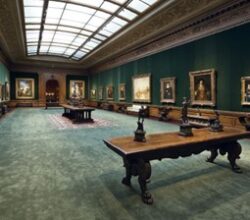
New York’s Frick Collection is beloved for its masterpiece-laden art that is housed in an opulent Gilded-Age mansion museum. After five years of renovation, it is verdict time. Where new spaces have been created, “the scars don’t show”. Old and new have been blended deftly, getting “the richest result from the smallest betrayal”. With its beautiful wood and brass finishes, silk and wool wall coverings and gorgeous marble, The Frick remains “a temple to the tangible”. The writer’s verdict – “phew”.

Is Art Criticism Getting More Conservative, or Just More Burnt Out?

For some time, there has been a rumbling debate (here and here) that we are experiencing “aesthetic stagnation”. The explanations are various – phone obsession, the digital world, art critics unaware of art history. This writer pushes back. We don’t know what our digital era will yet bring. Yes, “cultural platforms” have been upended by social media, but “cultural power” has been a battleground for ever. “Incredible work still happens, about as often as it always has; our jobs are … to find it”.

Astonishing Things: The Drawings of Victor Hugo at the Royal Academy review : ‘unnerving’

When Victor Hugo wasn’t writing Les Misérables etc, he sketched, drew or doodled. Most critics like his work, even though much of it “is very odd indeed”. There are humanoid mushrooms, “weirdly modern abstractions”, imaginary castles and more. Should these “competent” works be judged as if done by a “serious” artist? Perhaps not, because we are looking for other reasons, hoping for other insights. We look to see Victor Hugo, a great writer. And what do we find? Suggests one writer, “what an artist, what a soul”.