The Easel

29th March 2016

Interview With Guido Mocafico On His Current Exhibition, Blaschka

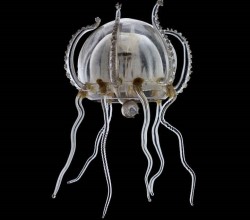
Before making Harvard’s famous glass flowers, the Blaschkas made models of marine animals. These exquisite objects are the subject of a photography exhibition. “[T]hey would spend days … just studying and copying from life. I sometimes compare them to the copyist monks of the 11th century, who dedicated their whole lives to copying the Bible. There’s something so mysterious and meditative about it.” More images are here.
The “radical” drawings of Indian artist Nasreen Mohamedi

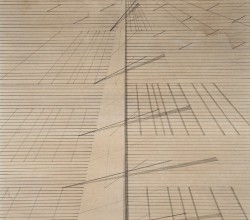
In her diary Mohamedi wrote “THE NEED FOR REAL AUSTERITY”. She showed this quality both in life and art. Rather than following India’s tradition of colourful figuration, Mohamedi’s delicate geometric abstractions hark back to older Islamic traditions. Little known outside India at her death in 1990, her reputation is now growing rapidly. Multiple images are in this short (1.7 min) video.

A Critic’s Job of Work

Why do we need art critics? In today’s hot art market “[t]he critic no longer has the power to participate in forming a consensus of value”. The argument here is that the critic’s real role lies elsewhere. “[T]he creative act is not performed by the artist alone; the spectator brings the work in contact with the external world. [Hence] the work can never be completed because … others will always be making their own contribution”.

Is that a Donatello in the MFA’s storage?

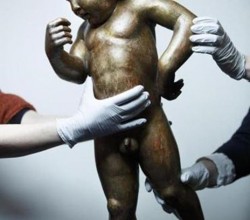
Two interesting stories in one. Donatello is a big name in Renaissance sculpture and the discovery of a new work by him is headline news. Between the lines, though, is a glimpse of the painstaking – and not always conclusive – art scholarship that produces these finds. “You see dozens, hundreds of things that are still missing …These things are out there — they’re floating around.”

Stephen Shore: Retrospective

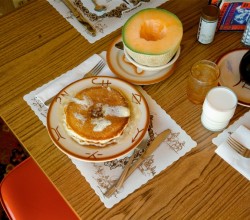
Success came early to Stephen Shore – MoMA bought some of his photos when he was just fourteen. Over a long career he has been a notable innovator, such as being one of the first to expand from black and white into colour. Never a believer in the importance of the “decisive moment” his acclaimed work focuses on supposedly mundane urban landscapes – a “chronicler of the unspectacular”. A video of images is here.

Patrick Hughes: the Pop Art pioneer who’s gone viral

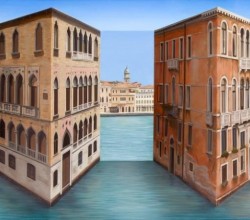
Hughes is a senior British artist and a gallerygoer’s video of his work has gone viral, with 19 million views. That is the kind of exposure that no gallery could hope to provide. Does this justify the writer’s hope that social media is a friend of the visual arts? Well, maybe. Hughes work – that uses perspective illusion to create an “Ah-Ha” moment– may be particularly suited to video. But who can tell what will go viral?

Looking forward through photography

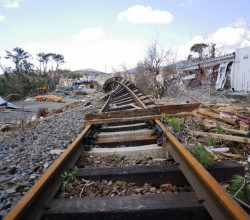
Two photography exhibitions of Japan’s 2011 tsunami tell different stories. A Tokyo exhibition, comprising recovered household photos “relentlessly” conveys the scale of the human tragedy. A New York exhibition of photographs by artists goes to a different issue. Even though Japan is culturally homogeneous …”a collective [reaction to the disaster] should not be taken for granted“. More images are here.

22nd March 2016

‘Van Gogh’s Bedrooms’ at Art Institute show artist’s quest for home

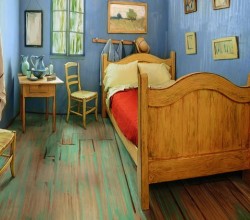
Side by side, Van Gogh’s three paintings of his Arles bedroom tell a story. Troubled by mental health issues, he lived in 37 places in his short life. Arles was a longer stay than most and it seems that his bedroom represented notions of home. “People look at that ‘Bedroom,’ and they think it’s the bedroom of a crazy man. It wasn’t. Not when it was first painted.” An excellent video (9 min) comparing the three versions is here.

The Disorienting Power of Al Held’s Black-and-White Paintings

Al Held was mentored by Rothko and had an early dalliance with abstract expressionism. But dimensionality attracted him. By the 1960’s he had left behind the AbEx theory of the “flat plane” and was painting hard edged geometric forms. “[Coupling diagonals and ellipses] with white shapes that could seem either solid or transparent … Held used these ambiguities to reintroduce the idea of imaginary space back into painting.”

Russian portraiture: Icons of early modernism

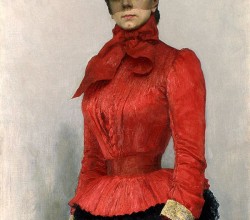
Although politically feeble, the last Russian czars presided over a remarkable cultural moment. Their last half century saw the emergence of Chekov, Dostoyevsky, Tchaikovsky, Tolstoy – and more. All feature in an acclaimed show at London’s Portrait Gallery. Taken together these portraits hint at a coming modernity in Russia and with it “the shattering of the old order”.

The Return Of The Prodigal Son In Art, In Order Of Prodigalness

The parable of the prodigal son, one of the Bible’s great stories of forgiveness, has been a favourite of painters for centuries. A small blog picks up on the theme and has some fun comparing renditions of the father – son reconciliation. ““You never even gave me and my friends a single goat,” … has to be the greatest complaint in the entirety of religious literature.”

How Paul Strand Paved the Way For Photographic Modernism

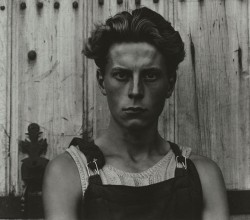
The New York group that included Alfred Stieglitz, Georgia O’Keefe and Paul Strand wanted their art to be distinctly American. Strand’s response to this challenge was to develop a sharply realistic style – “straight photography”. This term referred less to factual accuracy than high contrast, sharp focus and an awareness of geometric shapes- not a bad summary of much of 20th century photography.

A closer look at Ingres’ impossible ideals

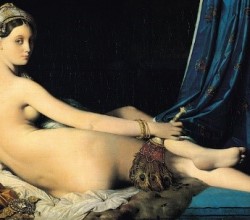
Lucien Freud said that to compare the drawings of Degas and Ingres was like comparing journalism to literature. Inges earned this exalted reputation with his portraits and nudes. But these works are a puzzle – reflecting classical ideals but showing unattainable women inhabiting oddly disjointed bodies. As one critic observed “[Ingres] used to be thought a terrible old square. Now he’s often seen as an exciting weirdo.”

The Little Man of Nuremberg

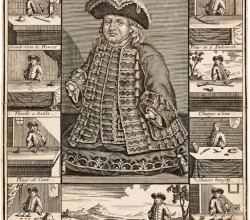
Matthias Buchinger’s story comes from the far periphery of art history. A dwarf without fully formed arms and legs he become a fairground performer of some celebrity. He also had four wives. History remembers him, though, for his talents in drawing and micrography (miniature writing). His dazzling penmanship (for which a magnifying glass is often needed) is currently on display in New York.