The Easel

1st September 2026

A Tribute to Yayoi Kusama

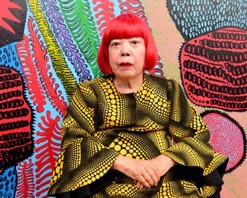
After a traumatic childhood, Kusama found that art helped with her mental health issues. Moving to the US in 1957, she created her famous art forms – phallic-shaped soft sculptures, infinity mirror rooms, pumpkin sculptures and fields of dots. Returning to Japan in 1973 she was seen as an embarrassment, but a later career revival brought huge fame. Her themes of infinity and self-obliteration reflected a desire to be “dissolved into the pattern.” Said she, “I am just another dot in the world.” Images are here.
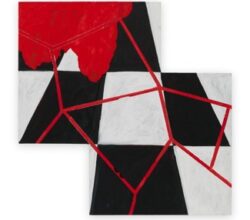
Mary Heilmann, Who Revivified Abstract Painting, Dies at 86

After training in California and a brief foray into ceramics, Heilmann moved to New York intent on “making it big” in sculpture. She didn’t, and in 1969 took up the supposedly dying medium of painting. Her “proudly unpolished” abstractions poked fun at the serious geometries of minimalism while radiating a “joyful humanity”. She continued to “uncork strange delights” until institutional recognition finally arrived in her late-60s.  Heilmann had “one of the defining art practices of her era”.

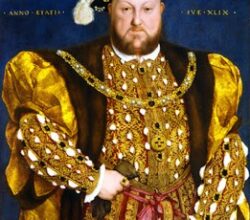
Often Overlooked, Tudor Art Richly Reflected a Turbulent Century of Growth and Change

We mostly associate the Tudor dynasty with its superstars, Henry VIII and Elizabeth I. Yet beyond their famous portraits there is a bigger art story. Vision was thought the most important of the human senses so art was used to shape political narratives. Henry VII used classical architecture to promote Protestant ideas while other monarchs supported artforms such as tapestry. Far from being a dynasty “barren of art”, the Tudors all used it to establish “courtly magnificence” and their own legitimacy.

How Japan Turned Department Stores Into Dreamworlds

Tokyo’s department stores are grand institutions, monuments to “beauty and abundance”. It turns out that they have also been agents for cultural change. Part of this was through their early adoption of  20th century technologies like lifts and lighting. More important was their use of posters for advertising. Lithography facilitated inventive poster designs and made posters hugely popular, an “art world sensation”. Essentially, they were addressing “a difficult question: what did modern life look like?”

In Sioux City, Disparate Visions of the American West Converge

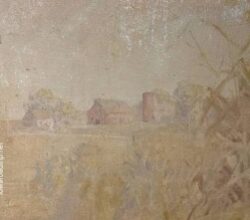
Before he painted his iconic “American Gothic” in 1930, Wood did a large mural of an autumnal Midwest corn field. Once regarded as merely an “artifact”, a restoration reveals it is a major work that depicts rural abundance. It marked Wood’s growing interest in Regionalism, an art movement focused on realist agricultural landscapes. Nowadays, Regionalist works anchor more contemporary art that addresses the “weighty emotions” rural Americans carry as they pursue “a successful modern life “.

25th August 2026

In Venice, Michael Armitage’s paintings are an emotional retelling of the political climate

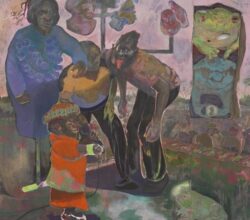
Armitage was Nairobi born and raised, but then trained in traditional London and now paints images that reflect these very different environments. Socio-political and identity issues are prominent, represented in a style that mixes the documentary and the dream-like. Painted in rich colours on highly textured bark cloth his work has a “lyrical, cinematic” quality. Such images, says Armitage, don’t “speak for somebody [but] speak to something”.

Women hate this artist’s boob obsession — men aren’t so sure

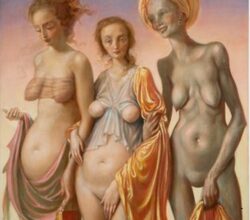
Critics have long puzzled about Currin’s paintings, and a London show continues the trend. Painted with great finesse, these images of women are drawn from 1970’s clothing catalogues and display a “cornucopia of boobs”. One writer suggests these are “images of desire, discomfort, and spectacle”. This writer pushes back. Currin is not being rude toward women but instead representing memories of women in his mother’s social circle. “Yes, there’s mockery [but] there’s a tenderness to be felt as well”.

New book ‘Chromatic Architecture’ celebrates colour as a ‘fundamental aspect of human pleasure’

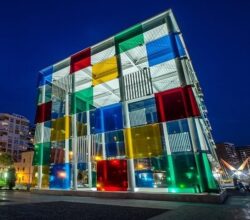
In art, colour is a fundamental creative element. In architecture, it seems to have a lesser role – sometimes no more than a finishing flourish. A new book advocates for a bolder approach. Not only does colour affect how we respond to a structure, but it can also “elevate a building to otherwise unachievable heights“. That’s an idea, it is suggested, that goes all the way back to the caves of the Neanderthals.

Fang sculpture stands taller than ever

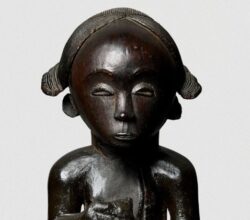
At first glance, this is a straightforward report on the market for African sculptures and masks. The huge prices indicate the immense aesthetic appeal of what one writer calls “masterpieces of premodern global art”. From there it gets complicated. Recent scholarship suggests Picasso, on first seeing these works in 1907, engaged in direct copying rather than painterly interpretation. And, as to how such objects can be shown in western museums, (assuming bulletproof provenance) that is still a matter of considerable debate,

The Grand Egyptian Museum

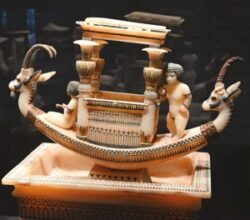
Although the museum officially opened last November, its crowning glory – the full contents of Tutankhamun’s tomb – is only now on display. Included are his personal possessions such as a carved calcite boat intended as a dining table centrepiece, and six chariots. A ceremonial chair made of ebony would have needed “a pile of cushions”. His spectacular funerary mask contains 10kg of gold and inlays of glass, obsidian and lapis lazuli. “I spent three full days in the GEM and look forward to returning”.

Is there such a thing as dangerous art?

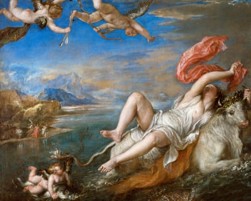
Titian’s painting The Rape of Europa (1560) depicts abduction and rape. Is it any different from a video game – another art form – containing graphic sexual assault? Is there an “ethical grid” that identifies good from bad? What about imponderables like the intentions of the artist or the merits of judging centuries-old art by today’s standards?  The power of art lies in its ability “to transgress“. Observes the writer, “depraved art is a many-headed monster”.