The Easel

28th April 2026

Marcel Duchamp at MoMA: Five Revelations From the Artist’s First North American Survey in Over 50 Years

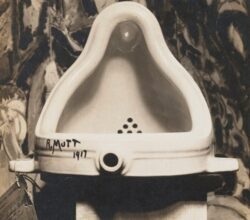
Duchamp is elusive. He lived life, says a writer, “on the cloud of his own airy wit”. Yet he was serious about art, proposing that the idea behind a work can be separate from the work itself. That idea has proved immensely influential, liberating artists to go off in all directions. It is a foundational argument to “dissolve the boundaries between high and low culture.” Further, it foreshadows a “techno-imagination”, images that are constructed to encompass machines and their increasingly central role in human life.
A Landmark Calder Exhibition with Over 300 of His Revolutionary Works Goes on View in Paris

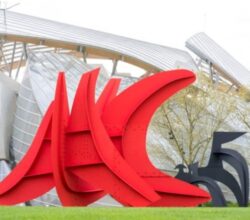
A huge Calder retrospective in Paris marks the 100th anniversary of his arrival there. Mobile sculptures are represented in such numbers as to remind viewers they were a “graceful leap in sculptural syntax”. Sculpture, once characterised by “volume and mass”, could also be dainty and not in a fixed position. Movement introduced time in a work, allowing Calder’s mobiles to” become a fluid part of their own environment.”

Brassaï – the secret signs of Paris

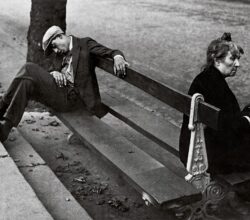
Brassaï got serious about photography around 1930 and just three years later published Paris by night. It established those quintessential Parisien motifs – lamplit cobblestone streets, alleyways, the metro. His even more famous Secret Paris of the 30’s, his “photographic zenith”, appeared in 1976 and remains a key example of “humanist photography”. What gives these images their ageless magic? Says Brassaï’s nephew, they “do not seek to document an environment, but to extract a latent truth from it”. Images are here.

Zumthor earns his L.A. stripes

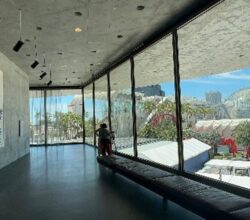
The new LACMA building was once called “suicide by architecture”. Now, after 20 years of work – and $724m – it is open. Despite fatigue from those years of controversy, reactions are unexpectedly positive. Yes, the concretework is imperfect. Bold artworks look great but smaller works can seem overwhelmed. Nonetheless, it is a fresh approach to the relationship between architecture and the display of artwork. “I can’t think of another museum building that operates quite this way.”

Sacred Parallelogram

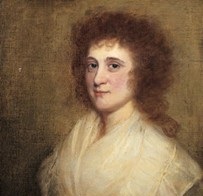
Two biographies detail why art history records so few female painters. Élisabeth Vigée Le Brun and Maria Cosway, born in the mid eighteenth century, were both regarded as child prodigies. Access to the art world depended on family connections and money. Training opportunities were limited. Marriage was perilous. Cosway’s husband jealously prevented her from selling her work. Le Brun’s husband was more supportive – so he could gamble away the proceeds. Any rational woman would surely just give up.

Hammershøi: The Eye That Listens

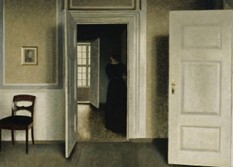
Hammershøi was taciturn, and don’t his paintings reflect it! Most were painted inside his Copenhagen apartment, showing sparsely furnished rooms, open doors, the occasional figure (often his wife) with her back turned, all painted in “dour colours” and conveying “emotional weight”. One writer likens them to Vermeer but with “none of the narrative drive”. Hammershøi did a few landscapes of the Danish countryside. In some the sun breaks through but, like his interiors, there isn’t much warmth.

Franz Xaver Messerschmidt and His Bizarre Character Heads

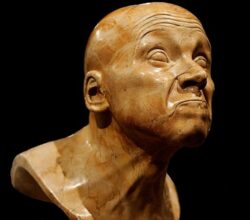
For someone relatively unknown the Viennese late baroque artist Franz Messerschmidt gets lots of exhibitions. The reason it seems is his perplexing series of 60 or so “character head” sculptures. Done in late career, they are highly detailed male faces showing various extreme emotions. Messerschmidt kept them for himself. Were they a reflection of his mental ill-health or just the Enlightenment’s fascination with faces? Says one critic “a lost soul of the European Enlightenment.” A detailed essay is here.

7th April 2026

How a humble print store in Cannes helped write modern art history

Printmakers doesn’t get many accolades. Galerie Maeght is an exception, having for decades produced lithographs and books by a who’s who of 20th century art. From the gallery’s origins in 1946, printmaking was a primary focus, a “laboratory” that produced ideas. Giacometti, for example, saw prints not as illustrations of his sculptures but as “siblings”. Further, such prints are “extraordinarily refined” and a way of making art – “collaborative, experimental, craft-rooted, unhurried – that has largely disappeared”.

‘New Humans’ and the Strange End of Contemporary Art as We Know It

The New Museum’s post-renovation show frames our current moment as one of “existential questioning”. Are we being replaced by algorithms or robots? Will our future be better with yet more technology or perhaps less? Many writers wonder what forms the new art will take but this sort of questioning surely isn’t new. It’s exactly what modernism was about. This writer offers up his description of the new art to come – “works that uniquely activate your sense of being a body in physical space with others”.

In the garden of the surreal

Dismissed by Coco Chanel as “that Italian artist who’s making clothes”, Schiaparelli was “one of the most dazzlingly inventive designers of the 20th century”. She had a “comet-like” rise to fashion fame in 1930’s Paris with clothes that were “witty, not just pretty”. Later artistic collaborations – Giacometti, Cocteau, Schlumberger and most frequently Dali – made her an avant-garde figure,  “prescient” according to one writer.. However, as tastes changed after WW2, both surrealism and her business foundered.

How much can we learn from the Shakers today? Many artists and designers are trying to find out

As a religious group the Shakers have nearly gone, but their material culture still looms large. Seeing work as a kind of prayer, they brought a religious sensibility to everything they made. Tools, clothing and most famously furniture, all display meticulous craftsmanship. Most have an austere design but not all. A plain looking sewing box has a “gorgeous inlaid lid”, exuberant artistry meant only for the user. The Shakers belief in simple durability is, says one writer, significant “for this era of egregious glut and waste”.

Get the kettle’s on

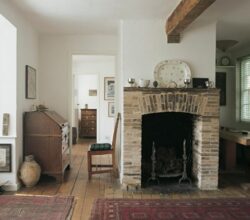
In an era when public museums are becoming huge, Kettle’s Yard is the “anti-museum”. Created by a former curator and comprising four amalgamated cottages, the founding vision was to create a space with “a lived-in beauty”. Small in scale, it makes use of natural light and does not use wall labels. Its art, mostly modernist, is shown in a domestic setting, “alongside fastidiously placed ceramics, wildflowers, feathers and pebbles.” One smitten writer calls it “one of the great oases of culture”.

In Defense of Pet Portraiture as a Worthy Art Form

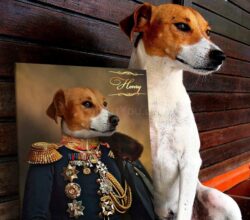
A polemic. Confession – your editor is neither a dog person nor even a pet person. Many others are. Apart from the horse portraitist George Stubbs, few artists focus on animals. Dogs are part of a “larger system” and creatures we should be “thinking with”. So why think of pet portraiture as “low art”? It is a way to study interspecies relations, something we should do to better understand the “more-than-human” world. Our concept of the “environment” is “bloodless, flat-footed”. Pet portraiture is the opposite.