The Easel

17th March 2026

Catherine Opie Documenting Marginalised Voices NPG

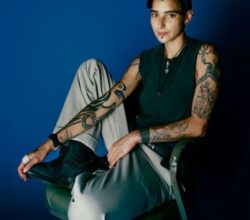
Admits Opie, “I had such a hard time fitting into the world as a girl”. That interest in identity has carried through into her art career that features photographic portraits of herself and friends, including some in the “leather and dyke scene”.  She is not trying to sensationalize or promote a “radical lifestyle”. Instead, she wants to represent, in a “painterly” way, a group who, she argues, are rarely seen in historical portraiture. “Doesn’t everyone have the right to actually be acknowledged in this world?
Beatriz González at the Barbican: brilliantly coded art that evaded the secret police

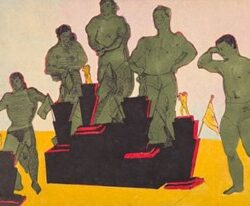
Although she didn’t see herself as a “political” artist, González did want viewers of her work to “feel assaulted”. Her paintings have a declarative style – graphic forms in vivid colours that reimagine media images. Despite their pop aesthetic, they are not optimistic works as they often address Colombia’s drug violence, state brutality and the disappearing of people. By the late 1990’s González’ work started using glowing blues, deep purples, the colours of sorrow. “I am all the [bereaved] mothers together”.

The People’s Treasures: Sharing Korea’s Cultural Heritage

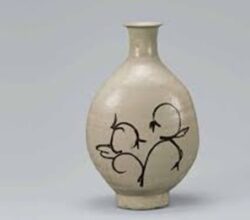
Korea’s Lee family, who founded Samsung, assembled an art collection so vast that it outshone the national collection. Much has now been transferred to public ownership and selected pieces are on show in Chicago. The oldest pieces are essentially Buddhist art, made for religious purposes. Later work – notably celadon ceramics – from the Josean dynasty (1392 – 1910) reflect Confucian beliefs. After the fall of the Josean dynasty, contemporary art has emerged in response to Western ideas. A video is here.

‘Negatives are photographic truths’: the collector who fled Russia with a haul of second world war images

Bondar, a Ukrainian photographer, sees war photography in especially broad terms. Besides including the work of professional photographers, it contains many images taken by less heralded photographers. Not having been manipulated, these represent a “collective memory” of terrible events. His WW2 images, assembled over more than a decade, are often conspicuous for their humanity, a “counterpoint” to conventional narratives of wartime heroism. Bondar’s website is here.

David Hockney review: The iPad paintings underwhelm but it’s hard not to be cheered by this show

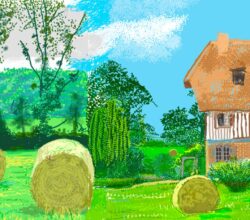
Hockney has described the approaching exhibition of the Bayeux Tapestry in London as “madness”. At the same time, he has produced a homage to that famous work, a 90m digital work that celebrates the seasons around his Normandy house. One critic calls this work of rolling fields, trees and paths “the masterwork of Hockney’s old age”. Others lament that such iPad images, with their “jolly colours” don’t have “painterly” qualities. “He’s forfeited the materialism of actual paint, that most valuable, tangible element of the process”.

Stubbs: Portrait of a Horse review – this magnificent nag deserves a longer canter

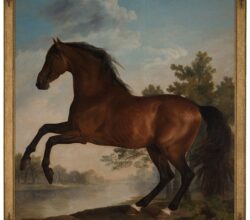
Why is this George Stubbs show so small, given that he was “as good as Constable?” It consists of just two of his greatest equine portraits, works that may be unsurpassed in the genre of animal portraits. His renown rests not just on anatomical fidelity but also his desire to show an animal’s “soul”. Stubbs was a product of humane Enlightenment thinking. His outlook, speculates the writer, was shaped by growing up amidst “the sight of human oppression in Liverpool, a slaving port.”

10th March 2026

Pat Oleszko

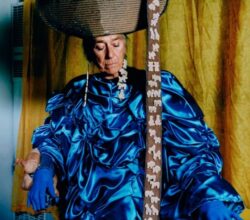
When Oleszko took up burlesque dancing as an art student, it foreshadowed a flamboyant career. Fifty years later, her performance art is being celebrated (and vindicated) with a show of her inflatable sculptures and meticulous costumes. Says she, “I think of myself as a sculptor who happens to be using my body as the armature. My ideas are primarily visual, and I activate them through words, movement and situation. [I am proud that] I can actually reach people in a way that is unprescribed.”

A Sweeping Retrospective for Artist Carol Bove Positions Her Among the Sculptural Titans

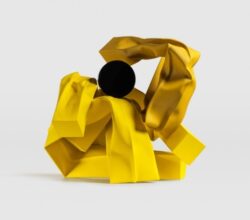
These days Bove does “big” sculpture but that’s not where she started. First came a decade of drawings, then conceptual assemblages of found objects and small sculptures and then, a decade ago, large looping structures.  Their contradictory qualities – hefty but with an air of delicacy – have made her reputation. Recent works incorporate found materials alongside brightly coloured crumpled steel.  Says a curator “I think Carol is putting a very feminist lens on that tradition [of masculine sculpture].”

Whitney Biennial 2026 Review: The Revolution Will Be Cute

Britain’s Tate Prize is a regular target for scorn. It seems that the Whiteny Museum’s Biennial plays a similar role in the US. This year’s show has no unifying  theme – something that one writer calls “incoherent” but another says reflects its thankless task of “capturing the zeitgeist”. Perhaps it is simply copying the “moods and maladies” of US culture and politics. If so, “that knockoff quality is precisely what gives art its shabby charm.”

Inside the Enigmatic Mind of Photographer Larry Sultan

Sultan’s interest in photography was sparked by billboard imagery. Later, his career turned to another piece of Americana – the suburbs of Los Angeles. These houses were often depicted, wrongly in Sultan’s view, as “generic structures for generic lives”. What he saw was “the complex and often dark and bewildering world of suburban life.” His images of bedrooms, backyards and fences, capture this ambiguity. Said he, “I don’t know what to make of things, and I like to give a viewer the same kind of openness.” 

Bird-Shaped Promises and Life After War: ‘Dagobert Peche: Ornamental Genius’ at the Neue Galerie

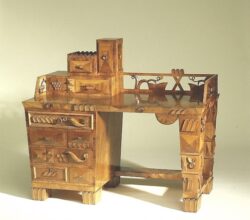
Paris has dominated the history of modernism, thus obscuring achievements elsewhere. Vienna Werkstätte was born out of the Arts and Crafts movement and emphasised simplicity and (geometric) clarity of shape in decorative arts objects. Peche, an Austrian designer, changed that with imaginative and opulent designs, inspired by the rococco. His creations ranged across metalwork, ceramics, textiles, wallpaper and jewellery. Peche was “the greatest ornamental genius Austria has produced since the Baroque”.

Blood on the Canvas

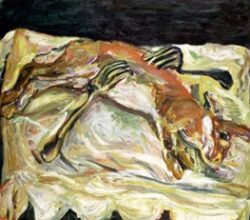
An American critic said of Soutine that “he had no biography outside his art … his art was a substitute for a biography”. If that is right, what is a new biography to say? It resists claims that the heightened emotional tenor of Soutine’s work reflected his “traumatic Jewish experience”. It also pushes back on the view that the privations of his early life shaped his art. Perhaps the emotion of Soutine’s work instanced something very common, the perpetual struggle “between humanity’s life and death drives”.

The Polite Art of Lending Loot

The state of play in the debate over restitution. Younger audiences and major sponsors are “less willing to associate with institutions that warehouse colonial loot.” As these pressures build, a common response is the long-term loan, an administrative “holding pattern” that involves neither an “ethical concession” nor a change in ownership. Claims of “universal custodianship” may ultimately fail to sidestep the crucial issue – how to balance the claims of originating communities with the interests of western viewers.