The Easel

27th August 2024

ESSAY: The ancient art of Keith Haring

Haring’s spectacular rise from rural Pennsylvania to art stardom in New York is well known. What is less understood, says Contributing Editor Morgan Meis, is what exactly he achieved. Some art critics at the time thought his work “simplistic” or populist. One called him a master of “witty illustration”. Haring himself seems not to have cared much either way.

Haring thought his street drawings enjoyed some kind of protection because the images were “a form of primitive code.  We’re talking about art as it is connected to ancient things like cult worship, ritual, magic. If Keith Haring’s art is good, it is good because it somehow mobilized the popular imagery of its time in order to create images that feel ancient … the sacred imagery of New York City.”
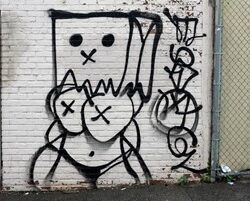
When Art Talks Back: Jonathan Lethem on Graffiti As Visual and Written Expression

Purely by chance, a companion piece to the Essay above – an appreciation of graffiti as a city’s dialogue with itself. “This devotional, graphomaniac, filibustering dimension of graffiti haunts me. It suggests tagging as a version of call-and-response, within a city whose cacophony of advertising, decay, and squabbling vernacular voices begs reply. Maybe it’s all a form of prayer—prayer to exist.”

Kandinsky’s hocus-pocus

What an odd bod Kandinsky was! Enthralled by Theosophy’s mysticism, he was advocating for abstract art as its “highest calling” as early as 1910. His views brought “fervour”  to his art but also detracted from its rigour with “arrays of wiry lines, random puffs of color, and pinched, convulsive rhythms.” Ultimately, “Kandinsky’s iconic abstractions scrabble for a uniformity that’s never forthcoming … outside of their historical context [his] paintings lose power.”

Keiichi Tanaami, pioneering Pop Art visionary, dies at 88

Tanaami had two formative childhood experiences, the WW2 bombing of his homeland and watching hundreds of American B-movies. They left him feeling that “truth and falsehood are mixed up”. Like Warhol, he came to art from advertising and his colourful graphic style reflected it. A surreal mashup of traditional Japanese motifs and Western pop culture, his art paved the way for Murakami’s superflat movement. Said Tanaami, “Manga-ish conception, manga-ish composition – I love them all”

How Pacita Abad Wove a Multicultural Tapestry of Humanity

One review notes Abad’s limited representation in major museums, presumably reflecting the usual bias against women artists. A big New York retrospective hints at change. Hers was a peripatetic career and her signature quilted paintings, once dismissed as decorative, are now seen as cosmopolitan. Variously depicting aquatic worlds, social-realist scenes of refugees and tribal masks, she created a “freewheeling artistic environment”. Asked about her artistic contribution in America, Abad said “colour”.

Were these Renaissance masterpieces some of the world’s first ‘viral images’?

A recognisably modern art world took shape in 15th century Belgium when booming trade brought prosperity to cities like Antwerp. Religious art had traditionally been favoured by nobles and the clergy. However, newly wealthy merchants also wanted glossy portraits and realistic scenes of everyday life. To help them, a new class of professionals emerged, art dealers. Art had become a “social spectacle … these paintings are about you and me and what it takes to be human.” Images are here.

20th August 2024

The Fury and Failings of a Nicole Eisenman Survey

The positive but not effusive reviews of Eisenman’s show when in London, are repeated now it is in Chicago. Noting the jumble of ideas and styles, the writer complains that Eisenman’s paintings “never quite resolve”. A more positive view is that Eisenman’s varied styles reveal her to be a “connoisseur of textures and coloured patterns”. In the last decade, she has become “very, very good” at articulating “an expanded repertoire of how to feel alive and… the possibilities of who we might be”.

Peter Kennard’s five-decade retrospective of political art and activism

Kennard’s retrospective is explicitly about political art. For some, this will recall the activism of the Thatcher years. But one might wonder if “DIY photomontage” has a late twentieth century print aesthetic. Political battles have moved substantially online. Will future Kennards be displaced by AI? Or will our image-saturated age simply deny such “knock-out” images the cut-through that they once had? Might we already know the future face of dissent … Banksy?

Leonora Carrington: The female surrealist Britain never understood

Surrealism advocated that art should reflect the unconscious mind. As a result, surrealist art is very personal, leading to a focus on artist biography rather than the art. Carrington is an example – much emphasis on her dramatic early story but not so much on her art. Famous in Mexico but overlooked in Britain, her work is “hard to love, and her weird, chilly inventions [are] resistant to interpretation”. Says another critic “Carrington’s mythological beings are irresistible … technically radical yet entrancing”.

The Neue Galerie Pays Homage to Paula Modersohn-Becker, the Mother of German Expressionism

Modersohn-Becker, prodigiously talented, spent her early career moving between a restrictive marriage in Bremen and artistic freedom in Paris. She died young, soon after childbirth. Two things make her story distinctive. First, her many self-portraits are now seen as boldly modern and done in a style that anticipates expressionism. Secondly, her early death leaves the perpetual question, “what if”.

A Scientist’s Quest to Decode Vermeer’s True Colours

Chemical analysis of the colour pigments in a painting can yield insights about the artist. Vermeer is a case in point. Using a remarkably limited palette – about 20 colours – he painstakingly layered multiple colours to produce his muted Delft interiors. And he seems to have had clear pigment preferences, notably expensive ultramarine blue and two different types of lead white. “As a painter of the prosaic …[Vermeer] implores us to slow down and look at the world in all its minute glory.”

Kasper König, Legendary Curator, Dies at 80

Although he worked mainly in Germany, the flood of obituaries for König attests to his global influence. He curated his first museum show at 23 and was, for decades, a freelance curator with an omnivorous interest in contemporary art. Involvements in the Venice Biennale, Manifesta and other global art events ultimately led to appointments as a museum director and art professor. A magazine once commented that “Kasper König doesn’t have a CV so much as a catalogue of bragging rights.”