The Easel

13th August 2024

I. M. Pei: A life in architecture

When Pei was studying architecture the Beaux Arts style was giving way to international modernism. It was an apt initiation for an architect famed for combining multiple influences. His most illustrious commission, the Louvre’s glass  pyramid, is acclaimed as a masterpiece in reconciling a modernist element with the museum’s traditional features, while also enhancing public space. Like many of his influential designs, it “connects past and future”. Images are here.

Start here: Michael Craig-Martin

A quick summary of Craig-Martin’s acclaimed work. He chooses to draw only those objects that are instantly recognisable. Once chosen, he renders them in a pristine, exact style, using familiarity to have us think the object is, say, a chair even though it’s not, it’s a drawing of a chair. This is, he admits, an “extreme form of representation” – things may be familiar even when not drawn realistically. ”Images are a form of language”, Craig-Martin says, and there is “slippage between idea and language and object”.

How the Hirshhorn Museum stays fresh at 50

What starts as a museum anniversary note morphs into something more interesting. US museums are struggling to rebuild visitor numbers after the pandemic. The Hirshhorn faces such challenges too, even though it is located on Washington’s National Mall and offers free admission. Populist shows have drawn people in while it considers bold ideas to be more than a museum – “a performance stage, a broadcaster and, at times, a public sculpture.” Somewhere amongst all that, one presumes, is the art.

Banksy’s phoney street art

New Banksy works are popping up in London, leading to this grumpy piece against his street art. The problem appears to be the “relentless lionisation by middlebrow media” who should instead focus on more authentic graffiti. Street art, Banksy-style, is a “lowest common denominator of hip” whereas graffiti has “genuine conceptual power”. As a way to show the human spirit, “graffiti does that far better than a stencilled goat.” But isn’t it possible that Banksy is just having “a great brat summer”?

Have Memes Ruined Art?

A new Substack newsletter that’s worth a look. The writer’s first post describes the visceral reaction that an original artwork can have on a viewer. Her second, more light-hearted, post looks at the contrasting problem of over-exposure – do we ruin famous artworks by turning them into memes? “No” seems to be the answer. We may roll our eyes at the way the Mona Lisa is “dishonoured”, but its meme-ification testifies to its prominence in our culture. “Memes cannot ruin art.”

Hockney and Piero: A Longer Look review: Just three paintings? Exquisite

This show – pairing one Hockney painting with two Piero works – has attracted multiple reviews, but what is it about? Is it admonishing gallerygoers to look more closely at works of art? Is it about artists referencing each other’s works? Perhaps it is simply Hockney’s fascination with Piero, a key Renaissance artist. The writer suggests one further idea – this is Hockney suggesting that artists should do more drawing, an activity he thinks is a foundational form of human expression. Take your pick.

6th August 2024

Silversmith & tastemaker

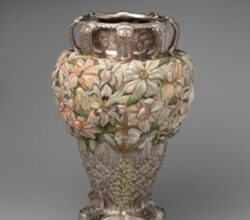
Charles Moore was Tiffany’s “house genius”. Not only a gifted designer, he collected objects from everywhere, opening his eyes to more sophisticated designs and varied technique. By the 1890’s Tiffany had driven an “aesthetic revolution”, shifting American tastes from rococo “nostalgia” to an embrace of Japanese and Islamic influences. Occasionally, it seems, Moore appreciated technique to excess. A vase from 1895, a technical “marvel”, is also the “ugliest thing Moore ever designed”. Images are here.

How Jeremy Frey changed the way the art world sees Wabanaki basketmaking

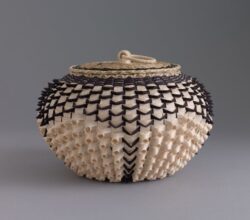
The Wabanaki, a group of Maine First Nations, have always made both decorative and working baskets. Frey was born into that tradition of weaving ash wood and sweetgrass but was inclined to “tweak”. His intricate baskets are now seen as contemporary art and have revitalised basketry as a form of Indigenous self-expression. Intones New York’s Met, which now has one of his works, Frey “merges Wabanaki Indigenous weaving methods with the symmetrical forms of classical European ceramics”.

Music for the Eyes: “Crafting the Ballets Russes” at the Morgan Library & Museum

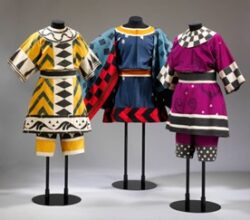
Gesamtkunstwerk is a mouthful – it’s the German word for combining multiple art forms into a “total work of art”. Nowhere is the idea better applied than to Ballets Russes, a 1909 spin off from Russia’s Imperial Ballet. It was an all-star affair – music by Stravinsky and Debussy, set designs by Picasso and Matisse, and dancers like the incomparable Nijinsky. On all measures, Ballets Russes was a cultural sensation, described by one writer as “an attempt of the twentieth century to create civilized pleasure.”

Massive tapestries at the Kimbell depict 1525 Battle of Pavia in impressive detail

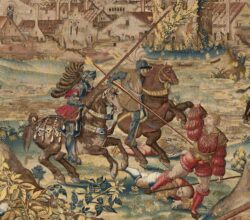
The Battle of Pavia in 1525 saw the Holy Roman Emperor (Charles V) vanquish the French. To commemorate, Charles turned to the most highly prized art form of the Renaissance, tapestries. Woven in fine wool and silk, with gold and silver highlights, the seven “monumental” Pavia tapestries took years to complete. Amidst many sumptuous details is the interplay of northern Europe’s attention to detail with the Italian preference for buff bodies. “Tapestries were indispensable to the articulation of authority”.

Here’s What You Need to Know About Chicago Imagist Christina Ramberg and Her ‘Furtive Figuration’

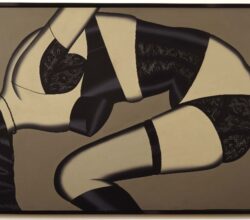
Ramberg came to prominence as one of the Imagists, a loose grouping of Chicago artists working in that city’s tradition of expressive figuration. From the start, she had a distinct aesthetic – a flat pictorial space showing isolated female hands, hair or torsos. A bit like comics, this was figuration with limited information. Ramberg’s paintings are especially striking, says one writer, because of their “strangeness … the byproduct of following a certain line of thought … often beautiful, deeply strange pictures”.  Images are here.

Captivating memories with traces of violence and death

Sami started painting in Saddam Hussein’s Iraq before fleeing to Sweden. A group of his works are on show at Blenheim Palace, a grand country house that celebrates “war and aristocracy”. Sami, though, is a refugee and his work – a mix of figurative and abstract – sits oddly in these bellicose surroundings. Yes, some paintings show military men but, with faces obscured, the tone is melancholy, not victorious. Unexpectedly, says the writer, art and house are “a marriage made in heaven”. (Google translate)