The Easel

8th December 2015

Bill Henson’s Bewitching ‘Anti-Portraits’ of Ballerinas

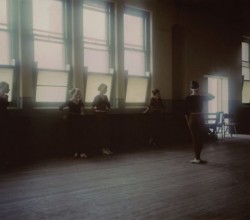
Bill Henson’s acclaimed body of work focuses on portraiture. A new book continues in this vein, including images of young ballerinas that could have come straight out of a Vermeer – dimly lit, sometimes blurry pictures that convey an elusive romanticism: “I’ve always had the feeling that it was what went missing in the picture that counted; that thing which is powerfully apprehended but not fully understood.”
Jeffrey Deitch on Why Figurative Art Rules the Zeitgeist, and His New Calling as a Pop-Up Impresario

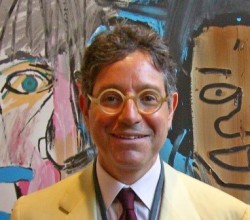
You just know that something is hot when it is the focus of a collaboration between Gagosian Gallery and Jeffrey Dietch. Figurative art is that new “hot”. Notwithstanding a slightly breathless tone, this interview with Dietch nicely profiles the argument about figuration, as well as his view that we are all suffering from abstraction fatigue. ”Figurative art is like the novel—it’s reinvented by every generation” More images are here.

Getting the Last Word: The 6 Most Withering Moments in Robert Hughes’s “The Spectacle of Skill”

Robert Hughes was copiously talented and he put those talents to good use. His Shock of the New and Nothing if Not Critical are widely regarded as classics of art criticism. Plus, he was thrillingly opinionated. Adam Gopnik says of him in this new volume “Robert Hughes was many things, but he was never a meta-thing. He was the real thing: living and breathing and red with exertion and, sometimes, rage.”

Image: Google

Francis Bacon in purgatory

Francis Bacon’s early paintings show figures in “desperate, nightmarish predicaments”. In later career, this shock factor mellowed out. A show in New York of his later work thus poses the question of whether the senior Bacon was resting on his laurels. Not really – “one does not get the sense… that Bacon had found peace in his work.  It makes more sense to say that his work found temporary respite.” More images are here.

Andrea del Sarto: The Renaissance Workshop in Action, Frick Collection, New York — ‘Diligence and caution’

Art history’s view of Andrea del Sarto was seemingly set when a contemporary bemoaned a lack of “a slightly more courageous and daring spirit”. A show at the Frick attempts a reassessment but this critic resists. Del Sarto’s shortcoming was not “casual flawlessness.” Instead, “The sketches offer glimpses … of an artist who understood life’s difficulties but preferred to…buff all the vibrancy out of crude existence”.

In Alberto Burri’s art, desperation and inspiration

Post-war US was brimming with optimism but Italy felt dispirited and diminished. Alberto Burri discovered art as a POW and began making paintings that were ”not so much paintings of ruins as ruins in themselves”. He influenced prominent American artists (especially Rauschenberg) but didn’t share their optimistic outlook. He remained in Italy and built a reputation making “art beyond illusion”.

1st December 2015

Jeff Koons, The Man With The Big Glass Balls

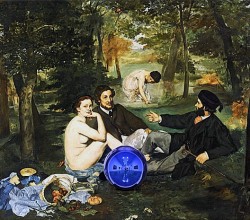
Fasten your seatbelt! Jeff Koons’ new show contains reproductions of 35 Old Masters each incorporating a shiny “bowling ball sized glass orb”. The artist suggests keeping an open mind. The response is apoplectic – “though judgment may be discouraged, discernment is OK. With Koons, do you shut it down with a hasty verdict or take your time to come to the same conclusion?” As Roy Lichtenstein might have said, KAPOW!!!

Michael Craig-Martin’s tour of his exhibition, Transience @ the Serpentine Gallery

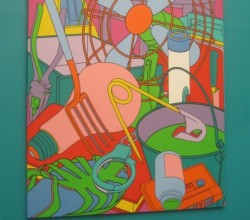
Fleeting technological innovations (remember Palm Pilots?) are the subject of much of Michael Craig-Martin’s work. His flat, minimal outlines in riotous colour sound generic but are completely distinctive – a 21st century version of pop art. The curators observe that Craig-Martin’s work “reveals a search for the ultimate expression of contemporaneity in a way that we all experience – through the items we use every day.”

Allen Jones: ‘The thing about eroticism is that it forces a response’

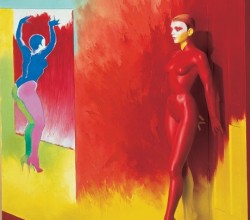
Abstract expressionism inspired British Pop artist Alan Jones’s to think afresh about figurative art. True to his word, he produced highly sexualized female forms that were hugely controversial. Now a celebrated member of the Royal Academy, he has no regrets: “I liked [the images] because they were dangerous… they suggested new ways of depicting the figure that weren’t dressed up for public consumption.” A short (2 min) video is here.

Iran Has Been Hiding One of the World’s Great Collections of Modern Art

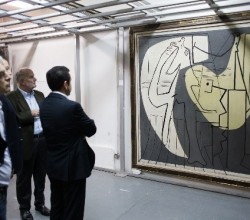
After the 1979 Iranian revolution a great collection of 20th century art, assembled by the Shah’s wife, became politically unacceptable. Amazingly, it survived the revolution, thanks to a museum staffer, and some pieces are cautiously being shown. ”As chaos engulfed Tehran’s streets, Shabazi spent most of the next two years locked in the vault with the artwork and the keys. “With this vault, with this museum, I am like a lion””.

Man on a wire: The playful simplicity of Alexander Calder

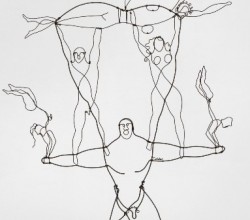
Last week’s Easel included a noted critic arguing that there is a sameness to Calder’s mobiles, now on exhibition in London. There may be some truth to this – if only because of the number that he produced – but it also surely understates Calder’s contribution to sculpture. Here, another noted critic offers a contrasting assessment – “[w]ho else but Calder could have made this unrelenting material [wire] so fluid?”

Exhibit review: In Virginia, a Rodin show changes how we see the sculptor

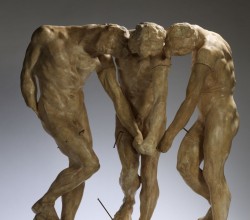
The Musee Rodin renovation (see last week’s Easel) has released key pieces for exhibition elsewhere. A US show uses the opportunity to focus on Rodin’s work methods. What is revealed is that his sculptures are “fundamentally heterogenous, joining the ancient and contemporary together without embarrassment … and with no effort to hide the dissonance… This is [close] to the contemporary idea of assemblage.”