The Easel

18th August 2026

Is the Twenty-First Century a Creative Void?

Interesting though dense. The late 20th century had a “profusion” of new cultural ideas but now we are in a period of “creative emptiness”. That is bad because an inventive culture benefits us all while kitsch “never asks us to change”. But haven’t we already got a surfeit of the completely new, such as our burgeoning, online world? Who says cultural originality is the only path to social progress? Kitsch – the repetition of familiar things – breeds new forms of subcultures and from those come new ideas.
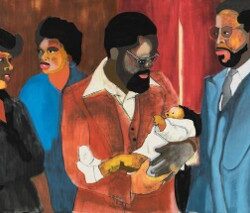
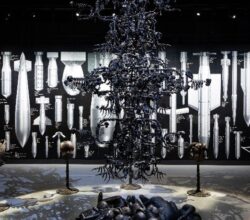
Derrick Adams: View Master

The challenge of a mid-career survey is to sum up an artist’s trajectory while it is still evolving. A case-in-point is Adams, whose colourful paintings of Black people at leisure convey “Black joy”. His figurative works are popular, but what is the enduring idea? One writer suggests it is identifying those banal moments “that make individual lives whole”. Or, says this critic, Adams shows how Black people can exist within a Eurocentric culture yet “create something else entirely”.

Dissidence for dummies

At Ai Weiwei’s first big show in London 15 years ago, he was hailed as an intellectually stimulating conceptual artist. A current show shows how much that reputation has shrunk. The works on display are often huge – a 49m inflatable boat, a three-tonne black glass chandelier, enormous flags – and address a profusion of issues. Some carry emotional impact while others are “self-aggrandising” or just “glib”. “Ai …  pretends to illuminate a problem whilst, in fact, obscuring it”.

The high summer of Finnish art

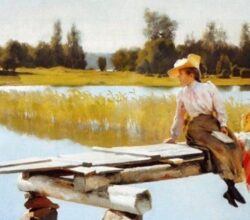
In the 1890’s, Finland was under the sway of Russia. Finnish artists, wanting to resist Russia’s ever-closer embrace, were drawn to painting realist images of the Finnish countryside. They variously highlighted the landscape, the lives of poor farming families or Finland’s effulgent summers. Influenced by Russian art and French impressionism, they crystallised “the country’s imaginative firmament” and made Finland’s presence at the 1900 World Fair the coming out of a soon-to-be national identity.

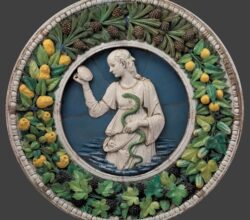
An Andrea della Robbia Masterpiece Is on View at The Met for the First Time in 70 Years

Andrea della Robbia trained as a goldsmith before developing a method of glazing terracotta sculptures and devotional bas reliefs. Not only was his glazing more durable than a painted surface, but colours like “della Robbia blue” gave sculptures “a lifelike presence and an ethereal force”. Even though their work became popular throughout Europe, the della Robbia’s kept their techniques a secret, so much so that when the family died out several generations later, those secrets died with them. A video (3 min) is here.

11th August 2026

‘An extremely rare perspective’ – Stuart Fallon on the photography of Sandra George

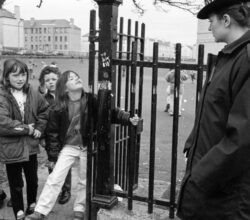
George is another photographer who never exhibited while alive. British born, she lived in Edinburgh, working as a community worker and photographer for local newspapers. After her death an archive of over 60,000 images was found in her garden shed. Those images depict “the personal and the local” – street protests, children at play, community scenes, self-portraits. They reflect on the agency that individuals have, the power of collective action and “the courage to speak truth to power”.

Which is the world’s most powerful art gallery?

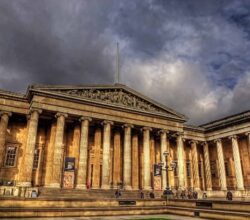
A not-entirely serious riff on a recent list of the 100 most-visited museums. Foot traffic is a necessary sign of “cultural influence” but far from sufficient. A superb collection – “wall to wall art bangers” – is also a must-have, plus the infrastructure to cope with the flow of visitors. Reputation maintenance demands that great works continue to be acquired. An historic collection, it seems, is wonderful but cold hard cash is almost as good. This (British) writer awards first place to – surprise – London’s National Gallery.

Portrait of a City review — a nostalgic stroll through a century of the American urban experience

A “nostalgic” exhibition that surveys a century of American photography. Stieglitz is generally credited with the first modernist photograph in 1907. From there America produced a roll call of great image makers, both men and women. Inevitably, much focus lands on that greatest of all melting pots, New York city. Some famous photographers, being recent immigrants, could empathise with their subjects “energy and appetite for change that is almost tangible”. Says one writer,  “exhilarating”.

Art Auctions

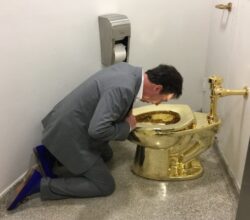
Spectacularly cynical take on a New York auction of “rich-guy art” that bores the writer “catatonic”. Many attendees “had brought their dogs—the better to help them imagine the art hanging in their living rooms, I suppose.” Once the sale starts “nothing can topple the awesome power of English accents.” The writer focuses on “a fully functioning, eighteen-karat gold toilet” by Cattelan. It sells for exactly the value of the metal it contained, nothing more. “It was, for once, an honest sale.”

When Art is Art: A Discursive Theory

Dipping a toe into the theory of art. No object is inherently art (!). Rather, art is defined by what a curator intends an object to do, namely contribute to a ”web of discourse”. Thus, sometimes an object will be art and sometimes not.   Is this a practical view? What if an object never provokes discourse, despite what a curator may wish? Aren’t we returning to exactly the point theoreticians wish to avoid, namely that qualities of an object do matter. Some objects are better at being art than others.

David Geffen Galleries

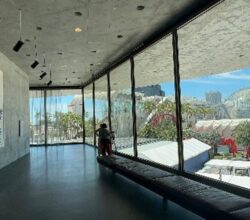
A renowned former art gallery director assesses LACMA’s dramatic building. A new building was sorely needed, and its exterior has “undeniable Brutalist power”. High internal natural light levels and raw concrete walls limit what art can be placed where.  “Shockingly”, the building allows barely 1% of the collection to be shown. Is the building just following the current popularity of “mixed-use lifestyle centres”? Pleasure is at the core of a museum experience but “art is [hopefully] not forgotten in the process”.