The Easel

22nd March 2016

‘Van Gogh’s Bedrooms’ at Art Institute show artist’s quest for home

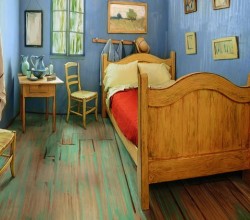
Side by side, Van Gogh’s three paintings of his Arles bedroom tell a story. Troubled by mental health issues, he lived in 37 places in his short life. Arles was a longer stay than most and it seems that his bedroom represented notions of home. “People look at that ‘Bedroom,’ and they think it’s the bedroom of a crazy man. It wasn’t. Not when it was first painted.” An excellent video (9 min) comparing the three versions is here.

The Disorienting Power of Al Held’s Black-and-White Paintings

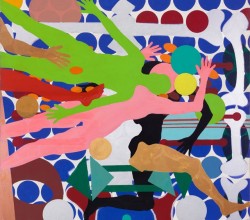
Al Held was mentored by Rothko and had an early dalliance with abstract expressionism. But dimensionality attracted him. By the 1960’s he had left behind the AbEx theory of the “flat plane” and was painting hard edged geometric forms. “[Coupling diagonals and ellipses] with white shapes that could seem either solid or transparent … Held used these ambiguities to reintroduce the idea of imaginary space back into painting.”

Russian portraiture: Icons of early modernism

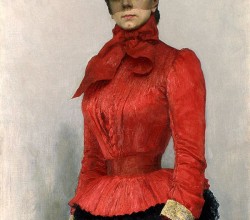
Although politically feeble, the last Russian czars presided over a remarkable cultural moment. Their last half century saw the emergence of Chekov, Dostoyevsky, Tchaikovsky, Tolstoy – and more. All feature in an acclaimed show at London’s Portrait Gallery. Taken together these portraits hint at a coming modernity in Russia and with it “the shattering of the old order”.

The Return Of The Prodigal Son In Art, In Order Of Prodigalness

The parable of the prodigal son, one of the Bible’s great stories of forgiveness, has been a favourite of painters for centuries. A small blog picks up on the theme and has some fun comparing renditions of the father – son reconciliation. ““You never even gave me and my friends a single goat,” … has to be the greatest complaint in the entirety of religious literature.”

How Paul Strand Paved the Way For Photographic Modernism

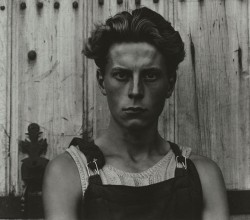
The New York group that included Alfred Stieglitz, Georgia O’Keefe and Paul Strand wanted their art to be distinctly American. Strand’s response to this challenge was to develop a sharply realistic style – “straight photography”. This term referred less to factual accuracy than high contrast, sharp focus and an awareness of geometric shapes- not a bad summary of much of 20th century photography.

A closer look at Ingres’ impossible ideals

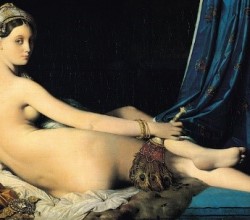
Lucien Freud said that to compare the drawings of Degas and Ingres was like comparing journalism to literature. Inges earned this exalted reputation with his portraits and nudes. But these works are a puzzle – reflecting classical ideals but showing unattainable women inhabiting oddly disjointed bodies. As one critic observed “[Ingres] used to be thought a terrible old square. Now he’s often seen as an exciting weirdo.”

The Little Man of Nuremberg

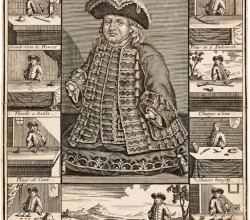
Matthias Buchinger’s story comes from the far periphery of art history. A dwarf without fully formed arms and legs he become a fairground performer of some celebrity. He also had four wives. History remembers him, though, for his talents in drawing and micrography (miniature writing). His dazzling penmanship (for which a magnifying glass is often needed) is currently on display in New York.

15th March 2016

Illuminating the Ethereal: Mark Rothko’s Work from His Son’s Point of View / Interview with Christopher Rothko by David Ebony

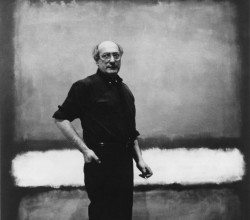
Although not an artist, Chris Rothko has forever been questioned about his famous father’s work. Now he has written a book that is a mix of personal reflections and art commentary. It challenges conventional wisdom about Rothko’s late black and grey paintings: “[T]hey are not dark. He was very depressed at the time … but the works themselves are very active. They are not about depression, they are full of determined energy.”

The Battle for Picasso’s Multi-Billion-Dollar Empire

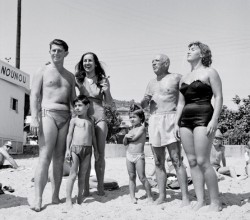
Picasso holds an endless fascination. When he died his estate contained 45,000 works (mostly uncatalogued) but no will. Family squabbles and ongoing authentication issues abound but there is no doubt about ongoing interest. “In 2016 he is the most reproduced, most widely exhibited, most faked, most stolen, and most pirated artist in the world …. “Everyone wants a piece of Picasso.””

Reunited in Moscow, Cranach paintings tell tale of Soviet-looted art

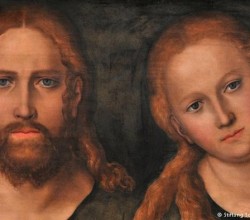
Works by the important German Renaissance artist Cranach the Elder were taken by the Russians in WWII. Ownership is still being disputed. Russian and German museums have sidestepped the issue to allow the first display of many works since 1945. And ownership? -“We Germans have to learn to understand the moral approach. These works came to Russia as compensation for all of the Russian art treasures which had been destroyed”

Know Your Critics: How to Understand Hal Foster, Godfather of Postmodern Art Theory

Art theory is not everyone’s cup of tea but this piece is worth dipping into. Hal Foster is an influential critic and art historian. He helped articulate the idea of post-modernism – art that is not the beautiful object (Rothko, Pollock) but something that is contingent on its context for meaning (Cindy Sherman). Most recently Foster has railed against at blockbuster exhibitions as “quick, superficial consumption”.

Roslyn Bernstein: Coloring the Grey Zone

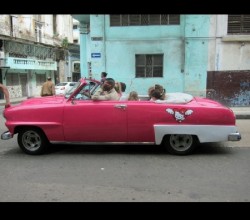
Senior Cuban artists are getting recognition abroad but what is happening inside Cuba? Quite a lot, it seems. The resumption of diplomatic relations with the US has created expectations of major change in the arts sector. Havana’s few official galleries all struggle to “replicate the model of the modern international gallery … Unofficially, art, both professional and amateur, can be found all over Havana these days”.

Van Dyck. The Anatomy of Portraiture

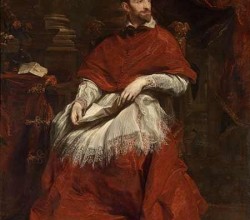
Van Dyck was his century’s greatest portraitist. Preferring to paint from life, he needed his sitters to make multiple studio visits. This gave him an opportunity to observe personality which became the intangible but animating quality of the portrait. “Great portraits bounce us back and forth between then and now, us and them … Great portraits have everything to do with what makes us all unique, and uniquely human.”

Image: Frick Collection

Kiki Kogelnik: Works from 1962-68

When Kogelnik moved to New York in 1961, she fell in with Pop’s heavy hitters – Lichtenstein, Warhol, Oldenberg. Unsurprisingly, this milieu impacted her own art, especially her use of colour. But she did not share Pop’s fascination with commercialism and always denied belonging to that club. Perhaps in vain – her native Austria celebrates her as a pop artist and the Tate’s big 2015 Pop survey included her work.