The Easel

15th September 2026

What’s Going on With the Met’s Odd New Giacometti Show?

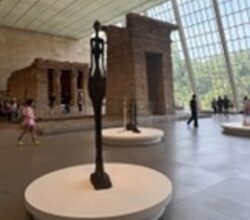
Giacometti was interested in simplified sculptural forms and liked the Egyptian sculptures he saw in Europe’s museums. He was also inspired, perhaps even more so – by the elongated figures in some tribal African carvings. A show that exhibits his gaunt, spectral figures around an ancient Egyptian temple thus connects loosely with his back story. But so what?  Curators are having fun mixing old and new objects but where is the narrative? “It is kind of a half-show, with a half-premise”.
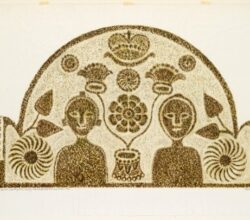

Another Life on Paper: “Here Lyeth: Grave Rubbings by Ann Parker and Avon Neal”

The Puritan communities of colonial New England were often austere. Nowhere was that clearer than in their graveyards. Death was commonplace and not sentimentalised. Gravestone carvings were varied, some restricted just to symbols that could be managed by local craftsmen. These carvings are a record of culture – of caring, of racism intertwined with acts of remembrance, of inevitable death. Many headstone carvings now exist only as wax rubbings on paper, a fragmented memory of what once was.

8th September 2026

The Lucas Museum Doesn’t Have a Narrative

The Lucas Museum of Narrative Art has taken 17 years to complete and required “fuck you” amounts of money. It displays all forms of art that tell a story – paintings through to comics, street art, posters and film. It’s a mash-up of high and low culture, something Lucas proudly calls “a temple to the people’s art”. But where is the explanation for why these objects belong together? This lack of contextualisation is “egregious … the Museum of Narrative Art lacks any kind of narrative. [It is] a vanity project”.

“Creatures of Myth and Imagination: Europe and the Americas” at The Met Cloisters

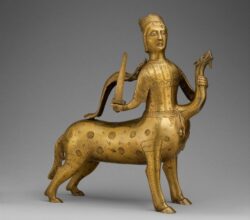
Up to about 1500CE, European artists imagined mythical creatures that combine features of animals and humans. Such imaginings were an attempt to explain the known world and express spiritual visions. In the Americas, completely independently, hybrid creatures were similarly being imagined that linked the human and the divine. These are beautiful and provocative objects, “a sampler of greater ventures hopefully to come.” Images are here.

“Avery, Gottlieb & Rothko: By the Sea” Shows How Three Midcentury Greats Were Shaped by the Shore and One Another

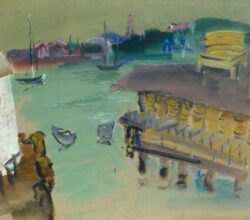
An American art history tale. Milton Avery was a pioneer of colour field painting – broad areas of flat colour. His younger friends, Rothko and Gottlieb were producing figurative work. The trio started summering together in the 1930’s where Avery encouraged them “to eliminate and simplify, leaving apparently nothing but colour and pattern”. Rothko was most influenced by this advice, ending up with his stacked rectangular fields of colour. Avery also evolved but never entirely let go of painting the sea.

Sophie Calle’s ‘Overshare’ Exhibition Takes Visitors on a Journey Through the Intimate

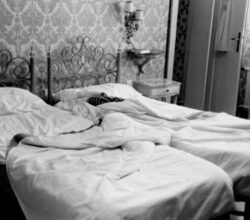
Calle anticipated social media by decades. She is fascinated by what we keep private versus the sometimes constructed personas we choose to make public. This has led Calle into projects like photographing occupied hotel rooms or following and photographing people as they move around their city. Despite her work being widely acclaimed she has never entirely dodged accusations of voyeurism. Claims she, it’s all about “the urge to see, to know, and to be known”.