The Easel

22nd July 2025

Amy Sherald’s Subjects

Sherald pays attention to her subject’s clothes, so much so that, according to one writer, “you cannot find fresher clothing in the work of any contemporary painter”. This points to what makes her portraits so different. Rather than revealing a subject’s interiority, Sherald is all about surface effect and the declaration of identity. Those who feel scrutinised in public “use appearance as a kind of armour, [It makes us] ask what it costs to present oneself with this degree of polish”.

Vija Celmins’s Retrospective Is Spectacularly Subdued

Celmins says her art practice tries to “re-experience … re-describe”. That obviously includes re-describing the night sky that she paints so exactingly but also applies to rocks cast in bronze and painted to look like the original, to desert landscapes, to seascapes, to clouds. They riff on the theme of real/fake but more than that they are “invitations to look closely. Her images speak quietly but insistently to fundamental human desires: to connect, to see, and to understand.”

From Syria to Mayfair via Berlin: Marwan gets the blockbuster treatment with Christie’s exhibition

A rarity – coverage of an Arab artist. Syrian-born Marwan studied in Berlin, but then stayed on, becoming a key figure in the ‘new figuration’ movement. It provided context for his obsession with the human face, variously shown in traditional portraits, obscured by cloth or represented in “face landscapes”. This variety reflected his hybrid background – Berlin and Damascus. Says one writer, Marwan’s art was “a step toward a contemporary Arab modernism.”

Collection View: Louise Nevelson

Nevelson gravitated to a branch of sculpture that has surrealist tinges – junk-assemblage sculpture. Her favoured material, wood and especially wood boxes, could be easily found on New York streets. One major work comprised 40 stacked boxes, each one a mini stage to be filled with “ornate bed posts, antique chair legs, picture frames, banister railings … “ and all painted black. Such works, she explained, were an ode to New York city, “the greatest collage in the world.”. A video (30 sec) is here.

9 Things to Know About Giorgio Morandi, the Master of Still Life

Morandi is an under-rated artist. He barely travelled outside his Bologna home, taught little and never joined any of Italy’s boisterous art movements. Yet his still lifes of bottles, oblivious to the 20th century, are hugely acclaimed. They are small architectural schemes, rendered in subtle variations of colour. They can be likened to Vermeer’s works, infinitely careful studies in pinpointing the true quality of ordinary things. There is no snappy quote from the linked piece – like the artist, it too is somewhat colourless.

When Does a Painting End?

The Florentine artist Daddi painted a Madonna image in 1335. Much later, a baby was added, perhaps covering up some damage. Was a decision in 1993 to “clean off” the baby justified? Daddi often added figures at the bottom of such images. The baby may have been added by his workshop which possibly helped create the original painting. And ill babies were likely brought before such a “miracle-working” Madonna. Muses the conservator, he “never felt convinced they had made the right decision.”

Sea Change: Uncovering Whistler’s Violet and Silver

Ever wondered whether art museums go overboard on conservation labs? If so, this piece is for you. Whistler was renowned for evanescent landscapes and pearly fogs, all of which involved subtle colour harmonies. Old yellow varnish ruined those effects. giving one of his works the “character of a laminated placemat”. Cleaning it restored the original colour scheme, revitalising the work and making it more readable. A slider that shows the “before and after” is a revelation.

15th July 2025

Emily Kam Kngwarray, Tate Modern review – glimpses of another world

London’s Tate is broadening its view of the art canon and holding a solo show of the Indigenous artist Emily Kngwarreye. It seems likely to further boost her already escalating reputation, with one critic calling it a “total knockout”.  The linked piece gets clunky where it tries to view her works too literally. One comment, though, is spot on: “a mesmerising overlay of dots in pinks, yellows, ochres, oranges, greens and lilac … the paintings are in a sense landscapes, they are not about looking at a view but being immersed in a place.” [Ed. I am currently writing a book about the art career of Kngwarreye}

Paolo Veronese, at the Prado Museum: “For his elegance, he is the Cary Grant of Venetian painting”

Veronese’s move to Venice in 1551 was gutsy. He would be going up against two great artists, Titian and Tintoretto, although he was only in his mid-20’s. Major accomplishments followed, notably psychologically insightful portraits and group scenes, painted in beautiful colours with “loose, quick” brushwork. Yet he is now rather overlooked. Unlike artists such as Caravaggio, Veronese was not an art world bad boy, causing trouble. He was. though, “one of the most important artists in Western painting.”

What If the Art World Isn’t Collapsing But Changing Hands as It Should?

All parties come to an end. It seems the art market is no longer booming, something especially noticeable at the high end. Enthusiasm in China for private art museums (it has over 2000) has cooled. Some have closed while others are in a ‘not dead-not alive’ state. In the US there has been a spate of retirements of prominent players. One gallery founder moans “I have never heard or seen more people speaking so bluntly about the crisis they’re feeling”.

Kengo Kuma’s ‘Paper Clouds’ in London is a ‘poem’ celebrating washi paper in construction

One of the notable exhibits at this year’s London Design Biennale was a Japanese work comprising hanging panels of washi paper. At one level the ethereal work suggested “sunlight breaking through clouds”, where the washi clouds “hovered between visibility and dissolution”. Besides being a sculpture, though, it was also an ode to washi, the paper with personality. Made with fibre from shrubs rather than trees, it is strong, light, textured, reusable and, most of all, poetic.

There’s more to the Bayeux Tapestry loan deal than meets the eye…

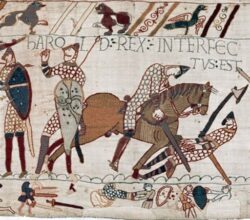
At 900+ years old, the Bayeaux Tapestry is as much cultural artifact as artwork.  Made with wool and linen by English nuns (probably), it commemorates the French victory in the 1066 Battle of Hastings. Its 58 scenes describe military gear, seafaring, and everyday life. The British Museum predicts that when it arrives in 2026, it will be “THE blockbuster show of our generation.”. Speculates the writer, perhaps the Tapestry loan foreshadows how the British Museum might eventually return the Elgin Marbles to Greece.