The Easel

5th March 2024

Catherine Opie Goes Into Her Archive to Illustrate Why Harmony Is Fraught

Opie’s images of LA’s gay community are notable because they combine the formalities of portraiture with photographic activism. Besides portraying members of her friendship circle her work includes images of LA city – “because I’ve always thought of the city as a body”.  This is Opie linking the public and the personal: “I’m trying to show all this beauty and all this love but, at the same time, remember that that beauty and that love … hits up hard a lot of the time.”
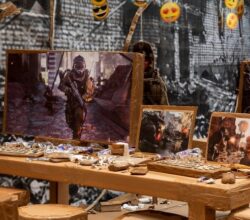
Thomas Hirschhorn

Hirschorn’s current show is described thus, “a den of mass delusion … long rows of [cardboard] workstations [surrounded by] binge paraphernalia.” One critic, more succinctly, calls it “clusterfuck aesthetics”. This is “social sculpture that gets its energy from the spontaneity of the street”, a mix of “the real and unreal”. Some find it “condescending … wilful, perhaps even undignified. Hirschorn’s art is an irritant [but] that might help us see the world more clearly”. A video of the artist (6 min) is here.

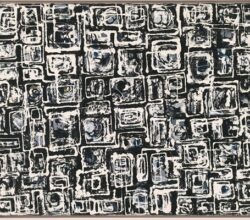
Lee Krasner’s Radical Reinventions

Art history’s gushing praise for Jackson Pollock left Krasner in the shade. That oversight is slowly being corrected, most recently in a show of her early work. Created during the turbulent Long Island years, it is a testament to her creativity. Starting with her grids of glyph-like symbols, she moved on to “brushy geometric abstractions”, then rectangular colour blocks and finally the angular abstractions of her mature style. “What courage it takes to turn heel and continuously become who you are.”

27th February 2024

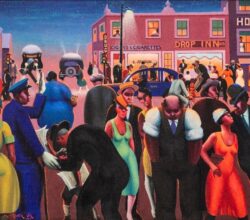
The Met is having a Black moment with the ‘Harlem Renaissance and Transatlantic Modernism’ show

The 1920’s Great Migration brought many Blacks to New York’s Harlem. New ideas about the “new Negro man” encouraged creativity in music and literature – the Harlem Renaissance. The visual arts, however, received scant attention, even though they produced a new “cosmopolitan Black aesthetic”. That aesthetic, says a curator, was a central force in American modernism because it “sought to portray the modern Black subject in a radically modern way.” Background on the Harlem Renaissance is here.