
The Easel

15th July 2025

Emily Kam Kngwarray, Tate Modern review – glimpses of another world

London’s Tate is broadening its view of the art canon and holding a solo show of the Indigenous artist Emily Kngwarreye. It seems likely to further boost her already escalating reputation, with one critic calling it a “total knockout”.  The linked piece gets clunky where it tries to view her works too literally. One comment, though, is spot on: “a mesmerising overlay of dots in pinks, yellows, ochres, oranges, greens and lilac … the paintings are in a sense landscapes, they are not about looking at a view but being immersed in a place.” [Ed. I am currently writing a book about the art career of Kngwarreye}

Kengo Kuma’s ‘Paper Clouds’ in London is a ‘poem’ celebrating washi paper in construction

One of the notable exhibits at this year’s London Design Biennale was a Japanese work comprising hanging panels of washi paper. At one level the ethereal work suggested “sunlight breaking through clouds”, where the washi clouds “hovered between visibility and dissolution”. Besides being a sculpture, though, it was also an ode to washi, the paper with personality. Made with fibre from shrubs rather than trees, it is strong, light, textured, reusable and, most of all, poetic.

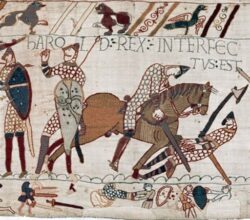
There’s more to the Bayeux Tapestry loan deal than meets the eye…

At 900+ years old, the Bayeaux Tapestry is as much cultural artifact as artwork.  Made with wool and linen by English nuns (probably), it commemorates the French victory in the 1066 Battle of Hastings. Its 58 scenes describe military gear, seafaring, and everyday life. The British Museum predicts that when it arrives in 2026, it will be “THE blockbuster show of our generation.”. Speculates the writer, perhaps the Tapestry loan foreshadows how the British Museum might eventually return the Elgin Marbles to Greece.

8th July 2025

The elephant in the room: India’s cultural influence takes centre stage

India’s story is illuminated through the devotional art of its great religions – Jainism, Buddhism and Hinduism. This art has amazing longevity – beginning about 2500 years ago – and boasts a sphere of influence right across Asia. Its sophisticated “cultural and linguistic apparatus” transformed cultures and yielded painting, sculpture, Zen meditation, haiku, Japanese ink wash landscapes as well as Ankor Wat and Borobudur. ” One of the most thought-provoking and aesthetically satisfying shows for years.”